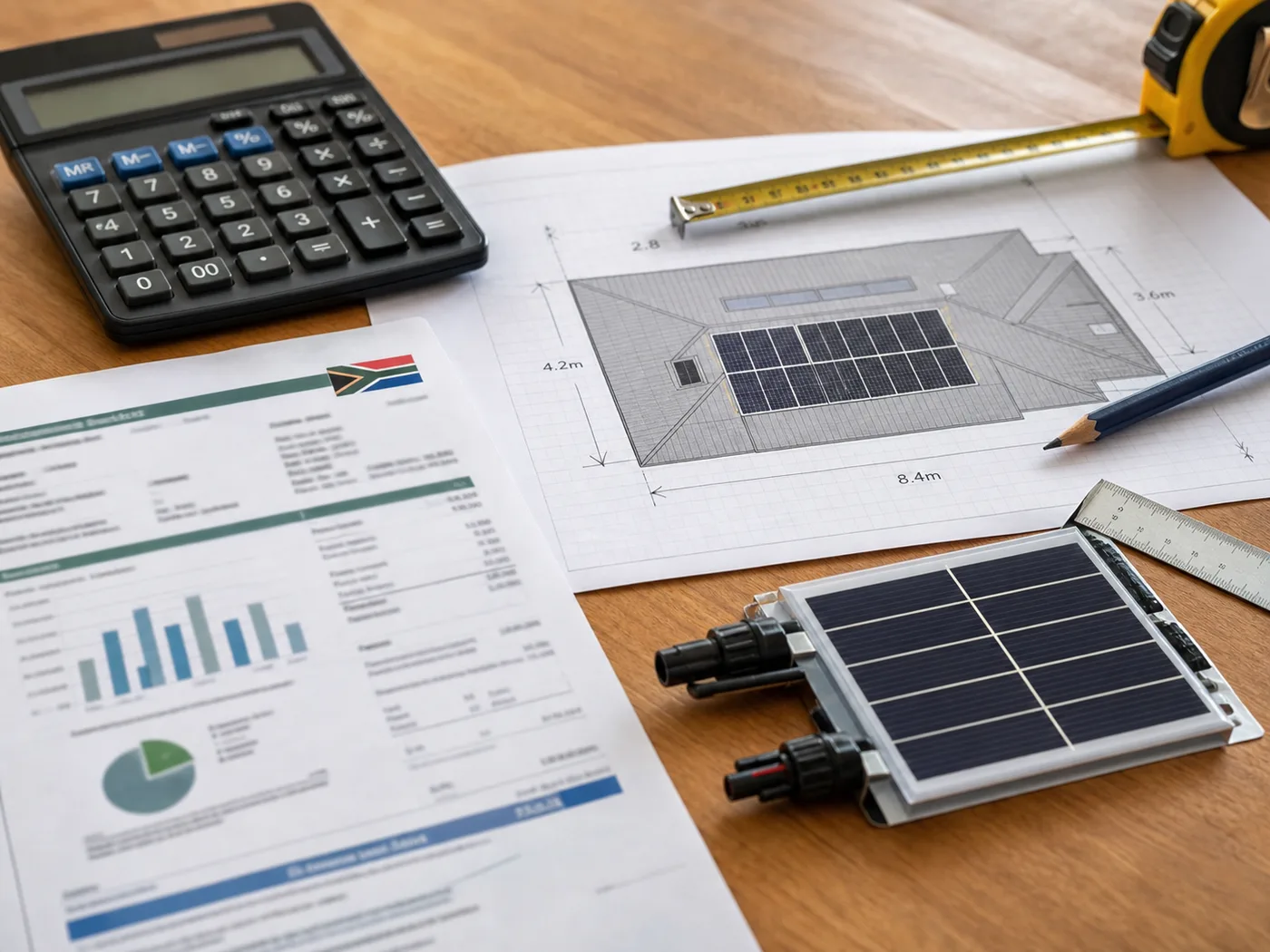
How a solar subscription works, step by step
1. You provide usage and property information
The provider usually asks for an electricity bill, address, property ownership or landlord details, and an idea of the appliances you want to run. Some offers are subject to affordability or credit checks.
Give the provider a full 12 months of electricity use if you have it. A summer bill alone can miss winter heating, while a winter bill can overstate year-round consumption.
2. The provider sizes and quotes the system
The quote should state inverter power in kW, usable battery capacity in kWh, panel count and total array capacity in kWp. It should also forecast annual generation and explain the assumed tariff, shade and self-consumption.
Do not accept "5kW system" as a complete description. A 5kW inverter can be paired with very different batteries and panel arrays. Check the proposed design with our guides to inverter sizing, battery sizing and panel count.
3. The home and roof are assessed
A site assessment checks roof condition, orientation, shading, distribution board, cable route, earthing and space for equipment. The provider should confirm any extra work and whether municipal registration is required before installation.
Ask who performs the installation and who remains accountable if a subcontractor is used. You should receive an electrical Certificate of Compliance and the relevant system documentation. Our SSEG registration guide explains the municipal side.
4. You sign the subscription agreement
The agreement sets the monthly fee, annual increase, minimum period, notice, included service, insurance, access rights, moving process and cancellation cost. This document matters more than the marketing page.
Read the equipment ownership clause and any purchase option carefully. An option to ask for a purchase later is not the same as building ownership with every payment.
5. The system is installed and monitored
Once commissioned, solar supplies the home during daylight, the battery shifts energy into other periods and the grid covers shortfalls. The provider may monitor equipment remotely and contact you about faults or performance.
You still need to manage peak loads. A 5kW inverter cannot run every high-power appliance at once simply because it is on subscription. See what a 5kW inverter can run for practical examples.
6. You pay monthly until you cancel, transfer or buy
The plan continues under its contract. When you leave, the provider may remove the system, offer a move or takeover, or allow a purchase. Notice periods and fees apply even when a service is described as flexible.
What does a monthly solar plan cost?
Published residential subscription offers checked on 20 September 2026 included:
- Alumo subscription from R1,299 a month, plus a R1,299 initiation fee;
- GoSolr battery-backed subscription from R1,399 a month;
- Versofy GROW from R1,799 a month, advertising 8 panels, a 5kW inverter and 5kWh battery; and
- Stage Zero on a property-specific quote.
Sources: Alumo, GoSolr, Versofy and Stage Zero.
These are different systems and contract models, so they do not establish a cheapest provider. Compare the expected annual solar output, usable battery energy, annual escalation and exit costs.
Also distinguish a subscription from solar panels "on instalments". Instalment finance usually works towards ownership. A subscription payment pays for continued use and service unless the agreement says otherwise.
What the monthly payment may include
A managed subscription may include:
- design and installation;
- inverter, battery and panels;
- remote monitoring;
- scheduled inspection or cleaning;
- covered maintenance and repairs;
- equipment insurance; and
- removal at the end, although removal may carry a fee.
The word "included" needs detail. Ask about call-out charges, labour, travel, battery degradation, storm damage, theft, insurance excesses and response times.
Alumo says insurance and annual maintenance are included in its subscription. GoSolr's published agreement describes monitoring, maintenance and annual cleaning/checking. Those public statements are a useful start, but your signed version controls your service.
Does the monthly price stay the same?
Not necessarily. GoSolr's published agreement applies a CPI increase each July. Other providers may use a fixed annual percentage or a price review clause.
A starting fee of R1,500 a month would total R90,000 over five years if unchanged. At a hypothetical 6.5% annual increase, it would total about R102,486. Ask for the monthly amount in each contract year so you can compare the real cash flow.
Who owns the solar system?
The provider normally owns all subscription equipment during the service. That affects what you may alter, move, insure or sell with the property. Get written approval before adding panels, replacing equipment or allowing another installer to work on the system.
Some subscriptions have a purchase option. GoSolr's published contract lets a customer request to purchase after three years at the contract price. That is different from rent-to-own, where transfer after the agreed payments is the core purpose of the product.
If ownership is important, compare a subscription quote with the same provider's rent-to-own or purchase quote using identical equipment.
What happens if you cancel?
There are four separate costs to check:
- fees during the notice period;
- an early-cancellation or deinstallation charge;
- repair and waterproofing after mounting hardware is removed; and
- settlement of unpaid amounts or damage not covered by insurance.
Alumo says cancellation is available after 24 months. Stage Zero advertises month-to-month service with three months' notice and says deinstallation fees may apply. GoSolr's contract lists fixed opt-out deinstallation fees by package size.
Do not describe any exit as "free" unless the provider gives you that in writing for your circumstances.
What if you move house?
Possible outcomes include a new owner taking over, moving the system for a fee, buying it before sale, or cancelling and paying for removal. Availability depends on the new property, provider coverage, credit approval and contract.
GoSolr publishes takeover, purchase and cancellation routes for a home sale. Stage Zero says relocation is available for a fee. Read our full guide to moving house with solar before choosing a plan on the assumption that it is portable.
Not sure which system you need?
Get a free, no-obligation quote sized to your home, usage and budget. It only takes a minute.
Get your free quote →Advantages and drawbacks
Advantages
- no full system purchase price upfront;
- one party responsible for covered equipment and service;
- potential monitoring, maintenance and insurance bundle;
- access to solar without taking ownership risk; and
- a defined cancellation route, subject to its costs and notice.
Drawbacks
- recurring payments while you use the service;
- annual price increases may apply;
- no automatic ownership or equity in the equipment;
- cancellation, removal or relocation can cost money;
- limited freedom to modify provider-owned equipment; and
- savings depend on correct sizing and actual household behaviour.
Questions to ask before signing
- What is the exact inverter, battery and panel model?
- What usable battery capacity and annual generation are expected?
- What is the payment in each year, including every fee?
- When can I cancel, how much notice is required and what does removal cost?
- Is there a purchase option, and how is its price calculated?
- What happens if I sell or move?
- Which faults, damage and battery degradation are covered?
- What response time applies when the system is down?
- Who handles the electrical certificate and municipal registration?
- Who repairs the roof after removal?
Use our solar quote comparison checklist for the installation and hardware questions as well.
Frequently asked questions
What is a solar subscription?
It is a monthly service that gives you the use of provider-owned solar and battery equipment. Installation and some maintenance are usually bundled, but inclusions, escalation and exit terms vary by contract.
Do I need a deposit?
Many providers advertise no upfront equipment price, but initiation, installation or other fees may still apply. Alumo currently advertises a R1,299 initiation fee on its entry subscription. Ask for every amount due before commissioning.
Do I own the panels after a few years?
Not automatically. A normal subscription keeps ownership with the provider. You own the equipment only if an agreed purchase or transfer takes place. Choose rent-to-own if contractual ownership after a defined term is the goal.
Will a solar subscription remove my electricity bill?
Usually not. You still pay fixed grid charges where applicable and buy electricity when demand exceeds solar and stored energy. The size of the reduction depends on system design and how you use power.
Is maintenance included?
It often is, but the scope varies. Confirm monitoring, scheduled maintenance, call-outs, labour, replacements, battery degradation, insurance and exclusions in writing.
How does SolarGuide make money?
SolarGuide currently earns referral fees from eligible Alumo quote requests. The provider, not SolarGuide, supplies and services the system. Prices and terms above were checked against linked public sources on 20 September 2026 and can change. Request an Alumo quote.
SolarGuide is an independent referral partner. We help you compare options and arrange a free quote — Alumo supplies, installs, finances and warrants the systems. Pricing is indicative, sourced from Alumo’s published catalogue, and subject to a site assessment and credit approval.