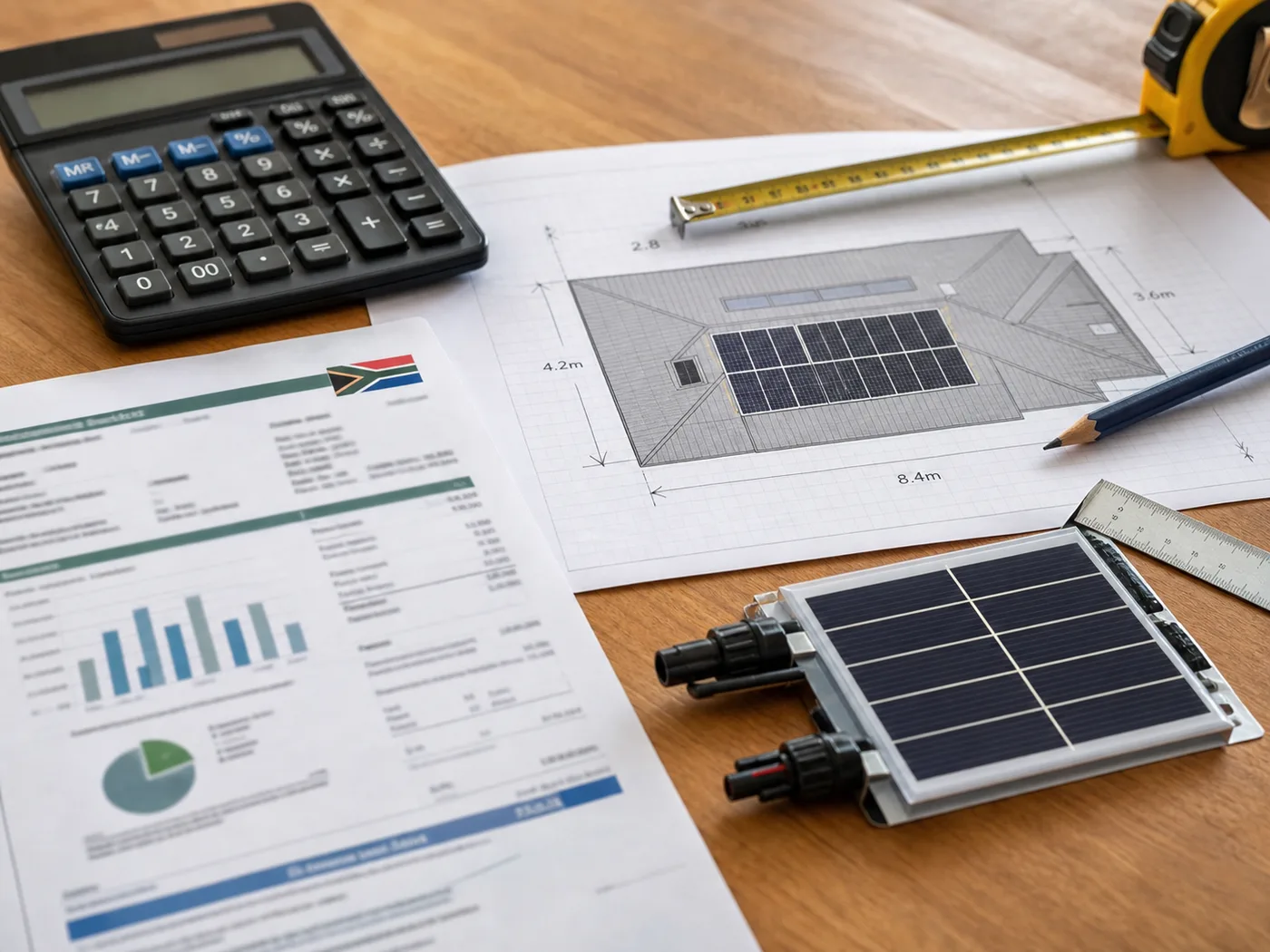
The same system can look very different as an outright purchase, rent-to-own plan or subscription. Compare the published package structures before you request a tailored quote.
South Africans can finance residential solar through a home loan, a dedicated bank energy loan, rent-to-own, a subscription or ordinary credit. Cash remains the simplest ownership route, but it is not the right benchmark if paying upfront would drain money needed for emergencies or expensive debt.
The right comparison is not "cash price versus monthly price". It is the total amount paid, who owns the system, what service is included, what happens if you settle or move, and whether the system actually reduces enough grid consumption to support the payment.
Finance options at a glance
Cash gives immediate ownership and normally the lowest acquisition cost.
A home-loan draw can offer a lower rate, but a long repayment term can produce more interest than expected.
A dedicated energy loan keeps a defined term and may accept an installer quote directly.
Rent-to-own spreads the cost and ends in ownership only after the agreement's transfer conditions.
A subscription pays for use and service, not automatic ownership.
Solar finance options compared
Route
Ownership
Typical term structure
Main cost to inspect
Main risk
Cash purchase
Immediate
None
Full installed price
Depleting cash and carrying maintenance risk
Home-loan finance
Immediate purchase, subject to lender security
Often flexible; can extend to the bond term
Interest over the actual repayment period, valuation and registration fees
Turning a short-life purchase into very long debt
Dedicated bank energy loan
Immediate purchase
Fixed instalments, commonly several years
Rate, initiation fee, service fee and credit insurance
Higher rate than secured lending
Rent-to-own
Transfers under the agreement
Commonly 3, 5 or 7 years
Escalation, initiation fee and final buyout
Focusing on the first payment instead of total scheduled cost
Subscription
Provider ownership
Open-ended or cancellable after a stated period
Escalation, notice and deinstallation
Paying for years without automatic ownership
Personal loan or credit card
Immediate purchase
Fixed or revolving credit
Effective rate and fees
Expensive unsecured debt
Every route may require affordability checks. A provider's use of "rental", "lease" or "instalment" does not settle the legal classification. Read the pre-agreement statement and signed contract.
Current bank solar finance options
This table was checked against official bank pages on 20 September 2026.
Bank
Publicly described route
Published details worth comparing
Absa
Home-loan further advance or re-advance
Solar and Energy Finance up to R300,000 over up to 7 years; qualifying variable-rate concession up to 0.20 percentage points; further advances may have bond registration fees
Standard Bank
Unsecured Energy Loan through LookSee
R300,000 maximum; 12 to 72 months; personalised rate up to prime plus 6.5%; R69 monthly service fee; initiation fee up to R1,207.50; no early-settlement penalty stated
Nedbank
New home-loan top-up, NedRevolve, re-advance, further loan or MFC asset finance
New home loan may fund up to 110% with the extra 10% for renewable energy; MFC asset finance advertised up to 96 months
FNB
Available home-loan funds, re-advance, further loan or Solar Energy Loan
Credit approval, property assessment and qualifying supplier documentation apply; nav Energy also provides purchase routes
These are product summaries, not approvals or personalised quotations. Rates, fees and qualification can change. Compare the bank's total-cost disclosure with the same installed system from your chosen supplier.
Option 1: pay cash
Cash separates the equipment decision from the funding decision. You own the system immediately, avoid interest and can choose your installer. The remaining costs are insurance, maintenance, failures outside warranty and eventual component replacement.
Do not pay cash merely to say you avoided finance. It may be a poor decision if it empties your emergency reserve or leaves high-interest debt unpaid. Compare the return from keeping the cash, the cost of your other debt and the risk of an unexpected home expense.
Home-loan finance is secured against property, which can make the interest rate lower than unsecured credit. You may use available funds, request a re-advance or further advance, or include renewable-energy funding in a new application.
The repayment period matters as much as the rate. At a hypothetical 11% rate, a R120,000 solar draw costs about:
Repayment period
Approximate payment
Approximate total
Approximate interest
5 years
R2,609/month
R156,545
R36,545
7 years
R2,055/month
R172,594
R52,594
20 years
R1,239/month
R297,270
R177,270
This illustration excludes lender fees and rate changes. It shows how a low monthly payment can hide a high total when the term stretches to 20 years.
Our solar home-loan guide explains re-advances, fees, term matching and bank-specific routes in detail.
Option 3: take a dedicated energy loan
A dedicated loan can keep the solar debt on a shorter schedule without changing your mortgage. Standard Bank's current Energy Loan is one example: it advertises 12 to 72 months, no early-settlement penalty, a personalised rate up to prime plus 6.5%, a monthly service fee and an initiation fee.
This route may suit a homeowner without accessible bond equity or someone who wants a clear settlement date. Compare the effective annual rate, credit-life insurance, service fee, initiation fee and total repayment. The lender may pay you rather than the installer, so you remain responsible for checking supplier quality and compliance.
Option 4: choose rent-to-own
Rent-to-own avoids the full purchase price and provides a contractual route to ownership. Current Alumo offers use 3, 5 or 7-year terms and include annual maintenance and insurance, subject to the agreement.
The starting payment is not the total. Alumo's current public Watt-a-Deal example starts at R1,418 a month but also lists 6.5% annual escalation, a R700 initiation fee and a R6,996 end buyout. The same page lists a R69,959 cash price for that system.
Our rent-to-own vs buying analysis calculates that published example payment by payment and explains early settlement, moving and ownership transfer.
Option 5: subscribe
A solar subscription charges for the use of provider-owned equipment. Service, insurance and maintenance may be included. Payments may escalate, and cancellation can involve notice and deinstallation costs.
Subscription can make sense if provider-managed equipment and a defined exit matter more than ownership. It is not an instalment purchase unless the agreement says that payments build towards transfer.
Match inverter power, usable battery capacity, panel array, installation scope, municipal work and warranties. A R1,400 payment for three panels is not directly comparable with a R2,000 payment for eight.
Ask for total cost of credit or scheduled payments
The National Credit Regulator's consumer-rights guide says a pre-agreement statement and quotation should disclose the amount borrowed, deposit, number of instalments, interest, charges, insurance and first and last payment dates for regulated credit. Ask for equivalent clarity even when the provider describes the product as a rental.
Stress-test the payment
Check affordability after:
every contractual annual increase;
a home-loan rate increase;
a reduction in household income;
an earlier-than-planned move; and
a grid bill that falls less than the sales estimate.
Keep finance and energy savings separate
First calculate the cost of acquiring or using the system. Then calculate electricity savings from expected generation and self-consumption. A system may be technically worthwhile but financed badly, or financed cheaply but oversized for the home.
Ask for written settlement values, cancellation notice, removal cost, relocation options and ownership status at each stage. If you may sell, see moving house with solar.
Not sure which system you need?
Get a free, no-obligation quote sized to your home, usage and budget. It only takes a minute.
Cash can suit a buyer with sufficient reserves who wants immediate control and the lowest acquisition cost.
Home-loan finance can suit a homeowner with equity who commits to a shorter voluntary repayment period.
A dedicated energy loan can suit someone who wants a separate fixed term and no mortgage change.
Rent-to-own can suit a settled homeowner who needs low upfront cost and wants eventual ownership.
Subscription can suit someone who values service and contract flexibility more than owning the asset.
There is no route that is cheapest, lowest monthly, most flexible and lowest risk at the same time. Decide which constraint matters, then compare total cost within that category.
Free planning tool
Solar finance and payback calculator
Compare cash payback with a financed system, using your own bill, tariff and assumptions.
R 2 500
R 110 000
70%
Payment route
Cash payback
5.2 years
20-year net saving
R 851 001
Year-one saving
R 1 750/mo
Estimated array
4.4 kW
About 8 × 550 W panels
Roughly 23.3 m² of usable roof
Indicative scenario only. It excludes finance fees, tax effects, maintenance, export credits and site-specific generation. The assumptions are visible below so the result can be challenged instead of treated as a quote.
Yes. Major banks offer energy loans or home-loan funding, while solar providers offer rent-to-own and subscription agreements. Approval, rates and available amounts depend on the applicant, property, supplier and product.
Which bank finances solar panels?
Absa, Standard Bank, Nedbank and FNB all publish residential solar or alternative-energy finance routes. Their products differ: some use home-loan equity while others offer separate loans. Compare fees, term, security and supplier rules.
What is the cheapest way to finance solar?
The lowest interest rate does not always produce the lowest total. A secured home-loan rate may be attractive, but a 20-year term can cost more than a higher-rate loan repaid in five years. Compare total payments for the same repayment period.
Is rent-to-own better than a solar loan?
Rent-to-own may include maintenance and insurance and require little upfront cash. A loan can give immediate ownership and clearer credit pricing. Compare the full payment schedule, service value, security and end ownership.
Can I still claim the residential solar tax rebate?
The SARS section 6C residential rebate applied to qualifying panels brought into use from 1 March 2023 to 29 February 2024. It is not a current rebate for a new 2026 household installation. Businesses have different tax rules and should obtain advice based on the asset and agreement.
How does SolarGuide make money?
SolarGuide currently earns referral fees from eligible Alumo quote requests. We do not arrange the bank products listed above. Product details were checked against official provider pages on 20 September 2026 and may change. Request an Alumo quote.
SolarGuide is an independent referral partner. We help you compare options and arrange a free quote — Alumo supplies, installs, finances and warrants the systems. Pricing is indicative, sourced from Alumo’s published catalogue, and subject to a site assessment and credit approval.