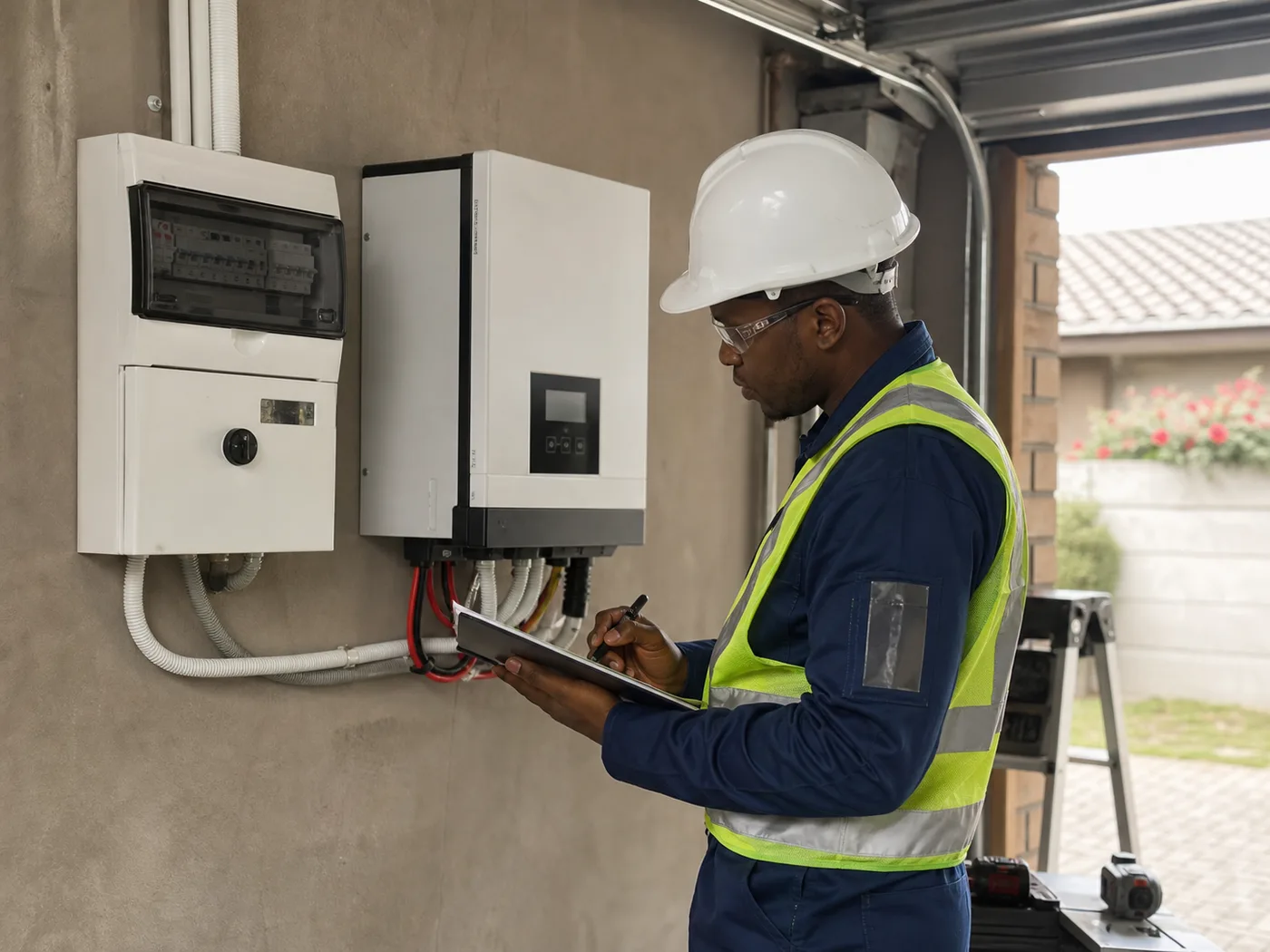
If your solar inverter is connected to the electricity grid, you normally need to register the system with the company that supplies your electricity. For most homes and small businesses, that means Eskom or the local municipality. The requirement applies even when the inverter is configured not to export electricity.
Buying Guide
Eskom Solar Registration: Fee Waiver Extended, Process and Cost

Installation guidance
Turn the checklist into a properly designed install
Once you know what a good installation should include, request an enquiry that covers system sizing, compliance, commissioning and after-care.
Eskom's fee waiver has been extended: what to do now
Eskom announced on 30 September 2026 that its waiver of registration-related charges has been extended until further notice. The extension applies to eligible customer-owned generation systems of up to 50 kVA connected directly to Eskom's distribution network. The previous 30 September expiry date no longer applies.
To register with Eskom:
- Check that Eskom, not a municipality, is named on your electricity account.
- Get three documents from your installer or electrician: a valid Certificate of Compliance, the inverter's NRS 097-2-1 type-test certificate, and an Embedded Generation Installation (EGI) test report. Eskom accepts an EGI report signed by an electrician registered with the Department of Employment and Labour.
- Submit your details and upload the documents on Eskom's online application portal. Eskom also lists provincial email addresses and its contact centre, 08600 37566, on its SSEG page.
- Once the application is approved, Eskom schedules the smart meter installation.
Registration is still required. The extension removes registration-related charges for eligible Eskom-direct customers; it does not remove the requirement to register a qualifying grid-connected system or to hold the relevant electrical safety documents. Eskom has not announced a replacement expiry date. Check its current guidance when applying, and ask your installer separately about any professional or corrective work you need to pay for.
Municipal customers, including those supplied by City Power, Tshwane or the City of Cape Town, are not covered by Eskom's waiver. They follow their own municipality's process and charges, explained below.
This process is called Small-Scale Embedded Generation, or SSEG, registration. It is separate from the electrical Certificate of Compliance issued for the installation. This guide explains who must register, which documents you need, how much registration can cost, and what changes if you want to feed surplus solar into the grid.
Key takeaways
- NERSA's February 2026 public clarification uses an installed-capacity threshold of 100 kW: grid-connected systems at or below it register with the distributor, while systems above it register directly with NERSA.
- Eskom's public SSEG guidance describes its route using 100 kVA. Because kW and kVA are not interchangeable, confirm the capacity basis for the proposed design with the distributor and NERSA.
- Registration and an electrical Certificate of Compliance are two separate requirements.
- Eskom extended its registration-related charge waiver until further notice on 30 September 2026. It applies to eligible systems up to 50 kVA connected directly to Eskom's distribution network; registration remains required.
- Municipal processes, fees and required professional sign-offs differ, so use the rules for the distributor named on your electricity account.
Who needs to register a solar system?
The deciding factor is whether the generation system has a point of connection to the electricity grid, not whether you plan to export power. In its February 2026 SSEG clarification, NERSA set out the current split:
| System | Where to register |
|---|---|
| Grid-connected system of 100 kW or less under NERSA's public clarification | Eskom or the licensed municipality that supplies the property |
| Grid-connected system above 100 kW under NERSA's public clarification | NERSA |
| No point of connection to the grid | Exempt from the NERSA registration requirement, although the distributor may require proof or notification |
A hybrid inverter is still grid connected when it can operate in parallel with the utility supply, even if its export limit is set to zero. A battery-only system may also fall within a distributor's embedded-generation process if it operates in parallel with the grid. Eskom's public material currently states its route in kVA, while the NERSA clarification reports kW. Ask the distributor and NERSA to confirm the capacity basis and treatment of your exact design before installation.
Registration is not the same as a CoC
An electrical Certificate of Compliance, or CoC, confirms that the electrical work covered by the certificate complies with the applicable installation rules. SSEG registration deals with the generating system's connection to the distributor's network. You may need both.
Our detailed guide explains what a solar electrical CoC covers and how it differs from municipal approval. If panels affect a building plan, sectional-title property or estate rules, read the separate guide to council, body corporate and HOA approval.
The SSEG registration process
The forms and sequence differ between distributors, but a residential application usually follows these stages.
1. Identify the electricity distributor
Check the supplier on your electricity bill. An Eskom account follows Eskom's process. A municipal account follows that municipality's process. Living in an Eskom-served province does not necessarily mean Eskom supplies your individual property.
2. Confirm the equipment before installation
The inverter needs the correct NRS 097-2-1 type-test certification and must satisfy the distributor's approved-equipment rules. Do not assume that every model sold in South Africa is accepted by every municipality.
This is one of the checks to complete when comparing solar installers and quotes. Ask for the exact inverter model, its certification, and written confirmation of who will manage the SSEG application.
3. Apply for permission where required
Some distributors want approval before work starts. Cape Town, for example, runs SSEG applications through the Energy Services section of e-Services and issues a Permission to Install letter. The City's official SSEG application page explains the current online process and the roles of the property owner, electrical contractor, installer and registered professional.
Other distributors allow an existing installation to be regularised. Do not use that as a reason to install first and ask later. Retrofitting an unsuitable inverter, changing protection settings or correcting diagrams costs more than getting the design approved at the outset. Businesses planning a larger project should include the connection path in the commercial site and load assessment before treating the design as final.
4. Install, test and document the system
The installer and registered electrical professional prepare the technical pack. Eskom currently lists three core documents for a standard application:
- a valid CoC signed by the registered person;
- the inverter's NRS 097-2-1 type-test certificate; and
- an Embedded Generation Installation test report.
Eskom says its basic EGI report for the simplified process may be signed by a Department of Employment and Labour registered Installation Electrician or Master Installation Electrician, excluding single-phase testers. A municipality may still require an ECSA-registered professional or additional drawings. Use the checklist issued by your own distributor.
5. Complete the distributor's approval and meter process
The distributor reviews the submission, may request corrections or an inspection, and confirms the connection terms. If you plan to export, you will normally need a bidirectional or smart meter and the appropriate tariff. A non-exporting system may still need metering or tariff changes under the distributor's rules.
6. Keep the approval pack
Keep the CoC, approved application, inverter certificate, drawings, test report and any permission-to-connect letter. You may need them for a property sale, an insurer, later system changes or a future export application.
Not sure which system you need?
Get a free, no-obligation quote sized to your home, usage and budget. It only takes a minute.
Get your free quoteWhat does SSEG registration cost in 2026?
There is no single national registration price. Costs can include an application or quotation fee, connection work, a meter change, professional sign-off, and corrections needed to make an existing system compliant.
For eligible Eskom-direct customers with systems up to 50 kVA, Eskom's 30 September 2026 extension waives registration-related charges until further notice. Confirm eligibility and the current conditions through Eskom's SSEG information and document portal. Do not assume the waiver pays for an electrician's documentation, professional sign-off or repairs needed to make an installation compliant; ask for those costs separately.
Municipal fees are separate. Some municipalities do not charge an application fee but still charge for metering, professional work or tariff changes. Others publish their own SSEG fee schedule. Confirm the total in writing before accepting a quote, including whether the installer's price covers:
- the application and technical drawings;
- the CoC and EGI or commissioning report;
- professional sign-off where required;
- the meter or tariff conversion; and
- resubmission if the distributor asks for corrections.
How long does registration take?
There is no reliable national turnaround time. A complete application using accepted equipment has the best chance of moving quickly. Missing signatures, an unapproved inverter, an incorrect single-line diagram or an account that does not match the property owner can hold it up.
Treat installation and registration as one project. The installer should explain which approval must arrive before work begins, when the CoC will be issued, and what evidence you will receive when the distributor closes the application.
Do you need SSEG registration to sell electricity?
Yes. Registration is the starting point, not the whole export arrangement. You also need an approved bidirectional meter and an export or net-billing tariff offered by that distributor.
Export credit is normally worth less than a unit of solar consumed in your own home or business. Size the system around your consumption and backup needs first, then treat exports as a secondary benefit. The guide to solar feed-in tariffs and net billing in South Africa explains how import charges, export credits and fixed charges fit together.
Questions to ask your installer
Before signing, ask for clear answers to these questions:
- Is the exact inverter model accepted by my electricity distributor?
- Does the quote include the CoC and every SSEG document?
- Who submits the application and responds to corrections?
- Does my municipality require permission before installation?
- Are professional sign-off, meter and tariff-change costs included?
- What documents will I receive when approval is complete?
SolarGuide can connect you with Alumo for an assessment and itemised proposal. Confirm the SSEG scope and any distributor charges in the final quote. Get a free Alumo quote →
Sources and update note
The fee-waiver guidance was updated on 3 October 2026 using Eskom's 30 September announcement. The registration process was checked on 26 September 2026 against NERSA's registration clarification, Eskom's SSEG portal and the City of Cape Town's application process. Distributor requirements can change. Commercial projects should also use the commercial solar approvals checklist to map property, engineering, metering and commissioning work. Confirm the final process with the supplier named on your electricity account before installation.
- NERSA's February 2026 SSEG clarification
- Eskom's current SSEG registration guidance
- Eskom's online SSEG application portal
- Eskom's 30 September 2026 fee-waiver extension
- City of Cape Town's SSEG application process
Frequently asked questions
Must I register if my inverter is set to zero export?
Usually, yes. NERSA says registration depends on the system's grid connection and installed capacity, not whether electricity is exported or consumed on site. Its February 2026 public clarification says a grid-connected system of 100 kW or less registers with the relevant distributor. Eskom's public guidance uses kVA, so confirm the unit and route for the proposed design.
Do I need to register a completely off-grid solar system?
A system with no point of connection to the grid is exempt from the NERSA registration requirement. Eskom may ask for a declaration and proof that the installation is fully independent. Confirm any notification requirement with the relevant distributor.
Is Eskom solar registration free in 2026?
Eskom's registration-related charge waiver continues until further notice for eligible customer-owned systems up to 50 kVA connected directly to its distribution network. Municipal customers follow their distributor's fees. Installer documentation, professional sign-off and corrective work may still have separate costs.
Can I still register after 30 September 2026?
Yes. Eskom extended its registration-related charge waiver beyond 30 September 2026 until further notice. Eligible Eskom-direct customers can still apply under the waiver. The extension does not remove the underlying registration or electrical safety requirements.
How do I register my solar with Eskom?
Apply on Eskom's online portal and upload a valid Certificate of Compliance, the inverter's NRS 097-2-1 type-test certificate and an Embedded Generation Installation test report. Eskom then schedules the smart meter installation.
Does the Eskom fee waiver apply to City Power or other municipal customers?
No. The waiver applies to eligible customers supplied directly by Eskom. If City Power, Tshwane, the City of Cape Town or another municipality supplies your property, follow that municipality's SSEG process and fees.
Can I register solar that is already installed?
Many distributors have a route for existing systems, but the installation still needs compliant equipment and documentation. It may require inspection or corrective work. Contact the distributor or a suitably qualified installer before submitting.
Can an installer register the system for me?
An installer can prepare and submit much of the technical application, sometimes through a formal proxy process. The property owner remains a party to the application and should keep the final approval documents. SolarGuide is an independent referral partner. Alumo supplies, installs, finances and warrants its systems; the final SSEG scope depends on the distributor and the signed proposal.
SolarGuide is an independent referral partner. We help you compare options and arrange a free quote — Alumo supplies, installs, finances and warrants the systems. Pricing is indicative, sourced from Alumo’s published catalogue, and subject to a site assessment and credit approval.

Ready to see what solar could save you?
Get a free, no-obligation quote. Share your average electricity bill and we’ll help you find the right system for your roof and budget.
Mon–Fri 8am–5pm · Sat 8am–1pm · Free quote across South Africa
Independent comparison service
NRS-aware guidance Provider terms made clear Compare payment options