How each one heats the pool
Pool heat pumps
A pool heat pump works like an air conditioner in reverse. A fan draws outside air over a coil filled with refrigerant, which absorbs the air's heat. A compressor concentrates that heat, and a heat exchanger passes it into the pool water flowing through the unit from your filter pump. Because it moves heat rather than making it, the unit delivers more heat than the electricity it uses.
That ratio is the coefficient of performance (COP). A COP of 7 means 7kWh of heat for every 1kWh of electricity. It isn't fixed: the warmer and more humid the air, the higher the COP. The US Department of Energy says pool heat pumps work efficiently while the outside air stays above about 7°C to 10°C, and lose efficiency as it gets colder. So a heat pump extends the season well, but it works hardest, and costs most, on the cool mornings and evenings when you want it most.
Solar pool heating
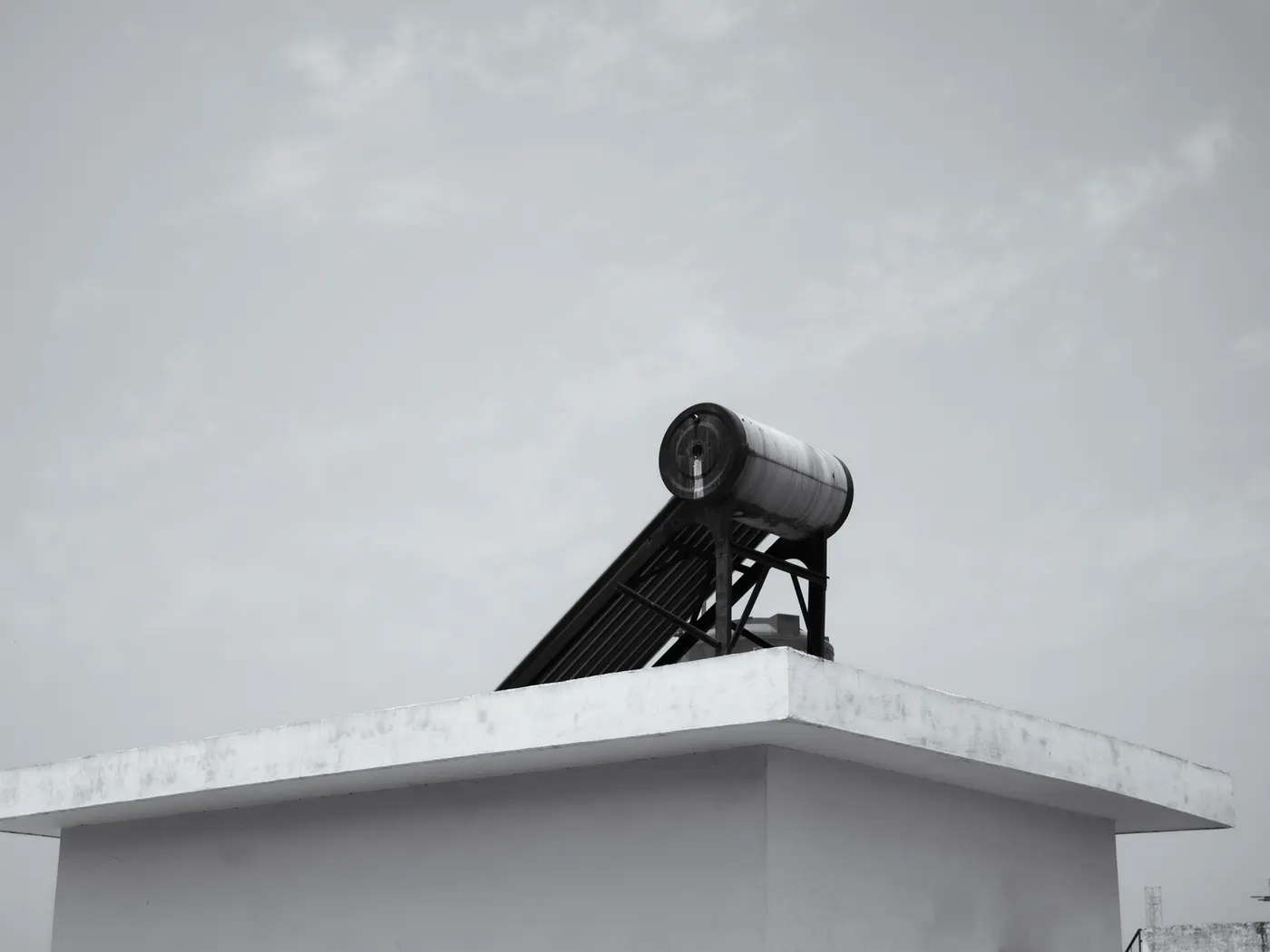
A solar pool heater has no compressor. Your filter pump pushes pool water through collectors, which are usually unglazed black rubber or plastic mats treated against UV, and the warmed water flows back to the pool. A valve, manual or automatic, sends water through the collectors only when they're warmer than the pool. The Department of Energy notes that in hot weather the same collectors can cool the pool by circulating water through them at night.
The running cost is mainly the extra pumping. You may need a bigger pump, or a second smaller one, to push water up to the roof and through the collectors. Ask the installer what the pump will draw and for how many hours. The trade-off is that solar heating only works while the sun shines on the collectors. It can't heat on a run of grey days or catch up overnight.
Side by side
| Pool heat pump | Solar pool heating |
|---|
| Energy source | Electricity, moving heat from the air | Sunlight on the collectors |
| Running cost | Electricity for the compressor and fan, plus the filter pump | Mainly extra pumping |
| Heats when cloudy or at night | Yes, at a lower COP when the air is cold | No |
| Space needed | A ground-level unit near the pool, with airflow around it | Collector area of roughly 50% to 100% of the pool's surface, usually on a roof |
| Electrical work | Connected by a registered electrician, who issues a CoC | Only if a new pump or controller is wired in |
| Can run on PV | Yes, if the solar system has enough spare daytime output | Already solar; its pump can run on PV |
Sizing basics: volume, surface area and the cover
Two numbers drive pool heating: the volume, which sets how much energy it takes to raise the temperature, and the surface area, which is where most heat escapes. Measure both before you ask for quotes.
- Volume in litres = length × width × average depth (in metres) × 1,000. An 8m × 4m pool with an average depth of 1.5m holds 48,000 litres.
- Surface area = length × width. The same pool has 32m² of surface.
Raising one litre of water by 1°C takes about 0.001163kWh of heat. For the 48,000-litre pool, that's about 56kWh of heat for every degree.
The Department of Energy says heat pumps are sized mainly on the pool's surface area and the gap between the pool and the average air temperature, with extra capacity for wind, low humidity and cool nights. It recommends a proper sizing analysis by a pool professional. For solar, it says collector area should be 50% to 100% of the pool's surface area, more in cooler or cloudier places and less if you use a cover. For our 32m² pool, that's 16m² to 32m² of collectors.
Why the cover matters most
The Department of Energy says evaporation is by far the largest source of a pool's energy loss, and that covering a pool when it's not in use is "the single most effective means of reducing pool heating costs", with savings of 50% to 70% possible. Eskom's own pool guidance adds that a cover limits water loss and cuts the time the pool pump needs to run to keep the water clean.
There is a small trade-off. A pool absorbs most of the sunlight that hits it, and a cover reduces that. The Department of Energy says a transparent bubble cover may cut the pool's solar gain by 5% to 15%, and a fully opaque cover by 20% to 40%. That is far less than the heat a cover saves at night, but it's a good reason to choose a clear bubble cover if you heat with the sun.
A cover also changes the size of everything else: a covered pool needs a smaller heat pump, fewer collectors and fewer running hours. Price the cover first, then size the heater around a covered pool.
What a pool heat pump costs to run: a worked example
This is an editorial calculation to show the method, not a quote or a guarantee. Your pool, climate, unit and tariff will change the answer.
Assumptions
- Pool: 8m × 4m, 1.5m average depth, so 48,000 litres and 32m² of surface.
- Heat pump: a 12.5kW unit. Midea's published datasheet for its MSC-120D2N8-A model gives 12.5kW of heat for 1.79kW of electricity (COP 7.0) with air at 27°C and water at 28°C, and 9.12kW of heat for 1.81kW (COP about 5) with air at 15°C. We use it only because it publishes both figures; it's an example, not a recommendation.
- Tariff: Eskom Homelight 60A, 343.61c/kWh including VAT, for 1 April 2026 to 31 March 2027. Municipal tariffs differ, so use the rate on your own bill. Our electricity tariff tracker lists current rates.
Cost of heat. At COP 7, each kWh of heat costs R3.44 ÷ 7 = about R0.49. At COP 5, it's about R0.68. A plain electric element, with a COP of 1, would cost the full R3.44 per kWh of heat.
Warming the pool by 4°C. That takes about 56kWh × 4 = 223kWh of heat. At COP 7 the heat pump needs about 32kWh of electricity, roughly R110. In cooler air at COP 5 it needs about 44kWh, roughly R152. A resistive heater would need about R767 for the same job. This ignores heat lost while warming up, so the real figure is higher, and much higher with the pool uncovered.
Running hours. At full output this unit costs about R6.15 to R6.20 an hour. If it ran flat out for eight hours a day, that's about R49 a day, or about R1,500 over 30 days. In practice, once the pool reaches temperature the unit only needs to replace the heat the pool loses, which is mostly evaporation. That's why a cover can make the difference between a heat pump that runs for hours every day and one that ticks over.
The heat pump also needs the filter pump running whenever it heats, which adds to the cost, as the next section shows.
Not sure which system you need?
Get a free, no-obligation quote sized to your home, usage and budget. It only takes a minute.
Get your free quote →The pool pump is usually the bigger everyday load
The heat pump only works in the months you swim. The filter pump runs every day of the year. Eskom says that cutting a pool pump's running time by one hour a day saves around 274kWh a year. That implies a pump drawing about 0.75kW.
At that size and Eskom's guidance of two three-hour cycles a day, the pump uses about 4.5kWh a day. At R3.44/kWh that's about R15 a day, or around R470 a month, all year round. For many pools, that's more over a year than the heat pump costs in a short swimming season.
Three things reduce it:
- Keep the filter clean and brush the pool. Eskom's advice is that good maintenance lets the pump do its job in fewer hours.
- Consider a variable-speed pump. ENERGY STAR says that halving a pump's speed cuts its energy use to about one-eighth, and that certified in-ground pool pumps use 20% less energy than standard ones. Ask what the pump draws at the speeds you'll actually run.
- Run it in the middle of the day. Eskom asks households to avoid 5pm to 9pm. If you have solar panels, midday is when they produce the most, and the pump can run on solar power without a battery.
Our guide to running a pool or borehole pump on solar covers the start-up surge that catches out under-sized inverters, and why you rarely need extra battery capacity for a daytime pump.
When it makes sense to add PV for the heat pump
A pool heat pump suits solar PV well on paper: it runs in summer, in daylight, when panels produce the most. Whether it works for your home depends on spare capacity.
In our example, the heat pump draws about 1.8kW and the filter pump about 0.75kW. With both running, the solar system needs roughly 2.5kW of spare output on top of whatever the house is already using. That affects both the panel count and the inverter. On a 5kW inverter, a heat pump and pool pump use half its capacity before the kettle goes on; our guide to what a 5kW inverter can run shows how that budget works.
PV is worth pricing for the pool when:
- You're installing solar anyway. Tell the installer about the pool pump and heat pump at the start, so the array and inverter are sized for them.
- You can schedule the heat pump for midday. A heat pump set to run from late morning to mid-afternoon uses solar output directly. Running it at night means paying for battery storage or grid power instead.
- You'd lose surplus power otherwise. If your system often fills the battery by late morning, the pool pump and heat pump can use output that would otherwise go to waste.
PV is a weaker fit when the roof space you'd use for panels is also the only place for solar pool collectors, or when you only heat the pool for a few weeks a year. In that case, a cover and solar collectors may do the job for less. Our guide to how much roof space solar needs helps you check what fits.
Ask for a solar quote that includes your pool pump and heat pump →
Which should you choose?
- You want a longer season at the lowest running cost and have a big, sunny roof: solar pool heating, with a clear bubble cover.
- You want reliable heat on cloudy days and into the evening, or your roof is small or shaded: a heat pump, sized for a covered pool.
- You already have, or plan, solar PV: a heat pump scheduled for midday, with the pool pump moved to solar hours too.
- You only swim in midsummer: start with a cover and move the pool pump to daytime. You may not need a heater at all.
Frequently asked questions
How much does a pool heat pump cost to run?
It depends on the unit's COP, your tariff, the air temperature and how much heat the pool loses. In our example, a 12.5kW heat pump at Eskom's Homelight 60A rate of R3.44/kWh costs about R6 an hour at full output and about R110 to warm a 48,000-litre pool by 4°C in warm weather, before heat losses. A cover cuts the hours it has to run.
Is solar pool heating better than a heat pump?
Solar heating is cheaper to run but only heats while the sun is out, and it needs collector area of roughly half to the full surface area of the pool. A heat pump costs more to run but heats on cloudy days and in the evening. If you have the roof space and mostly swim in summer, solar heating is hard to beat; if you want dependable heat, a heat pump is the stronger choice.
Do I need a pool cover if I have a heater?
Yes. The US Department of Energy calls covering the pool the single most effective way to reduce heating costs, with savings of 50% to 70% possible. Without a cover, much of the heat you pay for evaporates overnight.
Can I run my pool heat pump on solar panels?
Yes, if your solar system has enough spare daytime output and inverter capacity, and you schedule the heat pump for the sunniest hours. In our example, the heat pump and filter pump together draw about 2.5kW, which the installer needs to include when sizing the panels and inverter.
Is SolarGuide the installer?
No. SolarGuide is an independent referral partner for solar PV. Alumo supplies, installs, finances and warrants the systems, and we help you compare options and get a free quote. We don't sell or install pool heaters. All pricing is indicative and subject to a site assessment and credit approval.
Sources and review note
Checked on 20 October 2026. How heat pump and solar pool heaters work, heat pump temperature limits and sizing, collector area and the effect of pool covers come from the US Department of Energy's Energy Saver pages on heat pump pool heaters, solar pool heaters and pool covers. The live pages returned an error on the day we checked, so we link the Internet Archive copies from May and June 2026. Heat pump performance figures are from Midea's pool heat pump brochure (manufacturer data at stated test conditions). The tariff is from Eskom's schedule of standard prices for 1 April 2026 to 31 March 2027, Table 14. Pool pump guidance and the 274kWh figure come from Eskom's summer pool fact sheet and pool maintenance tips. Variable-speed pump figures are from ENERGY STAR. The worked example, pump size and running costs are SolarGuide calculations from these figures, not measurements. We have left out heat pump and solar collector prices because we couldn't confirm current, like-for-like installed prices; ask installers for itemised quotes.
SolarGuide is an independent referral partner. We help you compare options and arrange a free quote — Alumo supplies, installs, finances and warrants the systems. Pricing is indicative, sourced from Alumo’s published catalogue, and subject to a site assessment and credit approval.