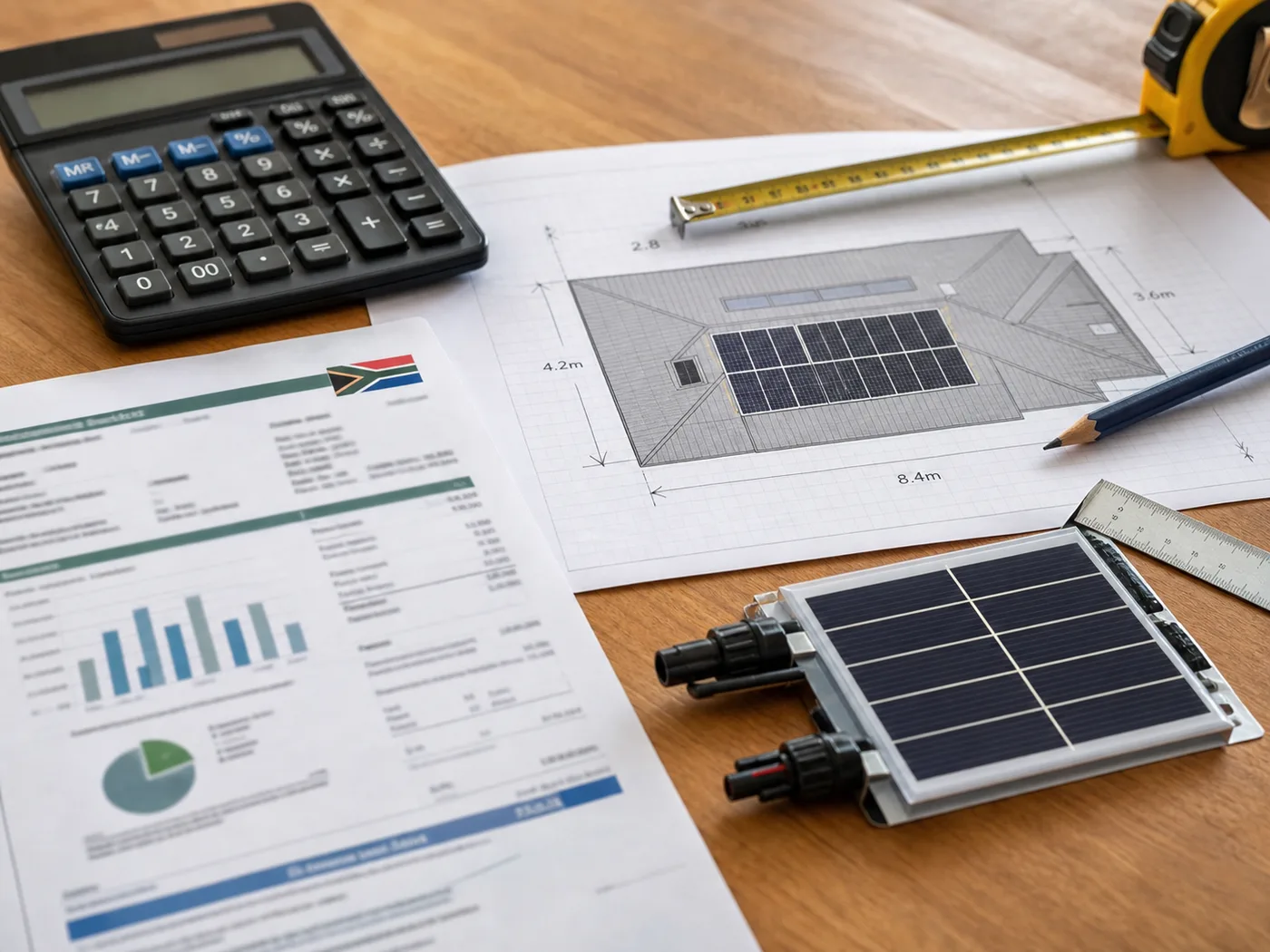
The same system can look very different as an outright purchase, rent-to-own plan or subscription. Compare the published package structures before you request a tailored quote.
Ask most South Africans what load-shedding costs them and they'll shrug — a few candles, some inconvenience, a grumble about Eskom. But the real bill is far bigger and far more hidden. It's the spoiled groceries you quietly rebought, the petrol you poured into a generator, the alarm battery that died early, the work you couldn't do, and the appliance that gave up after one too many power surges. These costs don't arrive as a single invoice, which is exactly why they're so easy to underestimate.
When you add them up honestly, load-shedding turns out to be one of the most expensive recurring problems in the average household budget. It is also worth keeping the scale in view: load-shedding hours fell sharply in the past year, while tariffs kept climbing — the current South African solar statistics set both trends side by side. And here's the part people miss: the same money bleeding out through those hidden costs is often enough to fund a solar system that stops the bleeding and cuts your Eskom bill on top. Let's do the maths properly.
Key takeaways
Load-shedding's real cost is hidden across food spoilage, generator fuel, replacement batteries, lost work and damaged appliances.
These recurring costs quietly add up to thousands of rand a year for a typical household.
Solar reverses the equation: it eliminates the outage costs and cuts your grid bill every month.
With financing, a solar system's monthly instalment can be less than what load-shedding is already costing you.
The costs you can see
Some load-shedding costs are obvious once you total them.
Spoiled food. Every extended or back-to-back outage puts your fridge and freezer at risk. A single freezer's worth of meat and frozen goods can run to a serious sum, and it doesn't take many spoilage events a year to add up. Most households absorb this quietly, rebuying groceries without ever tallying the total.
Generator fuel. If you bought a generator to cope, you're feeding it petrol or diesel every time the power goes. During a heavy month of load-shedding, that fuel bill alone can run into hundreds or thousands of rand, and unlike solar, every cent of it is gone the moment it's burned.
Candles, gas and gadgets. The rechargeable lamps, gas refills, power banks and UPS units are individually cheap, but they're a steady trickle of spend, and the batteries in them wear out and need replacing.
The costs you don't see
The bigger numbers hide in places you don't immediately connect to load-shedding.
Dead alarm and gate batteries. Every outage cycles your alarm, gate and CCTV backup batteries. They're designed for occasional dips, not repeated multi-hour drains, so heavy load-shedding wears them out years early. Replacing these batteries across your security kit is a recurring cost that traces straight back to the grid.
Damaged appliances. Power surges when electricity is restored are a well-known hazard, and over time they degrade or kill sensitive electronics: TVs, fridges, computers, the very appliances you rely on. One dead fridge or TV can dwarf a year of every other load-shedding cost combined.
Lost productivity and income. For anyone who works from home, runs a small business, or simply needs to be online, every outage is lost time. For a home-run business, a hairdresser, a home office, an online seller, it can mean lost revenue outright. This is the cost that's hardest to quantify and often the largest.
Put the visible and invisible costs together and the annual total for a typical household comfortably reaches into the thousands, often many thousands, of rand a year. And none of it buys you anything. It's pure loss, repeated for as long as load-shedding continues.
Not sure which system you need?
Get a free, no-obligation quote sized to your home, usage and budget. It only takes a minute.
Here's what makes solar different from every other response to load-shedding: it's the only one that turns a cost into an investment.
Every other option (generators, UPS units, candles, replacement batteries) is money spent to survive the problem. You pay, the power comes back, and you've got nothing to show for it but a temporary reprieve. Solar is the opposite. From the day it's installed it does two jobs at once:
It eliminates the outage costs. No more spoiled food, no more generator fuel, no more prematurely dead security batteries, no more surge-damaged appliances, no more lost work time. The problems that were draining thousands a year simply stop.
It cuts your Eskom bill. Because your panels generate power you'd otherwise buy, your monthly electricity spend drops — every single month, whether load-shedding happens or not. That saving continues long after load-shedding is a memory.
So instead of paying twice — once to the grid and again to survive its failures — you're building energy independence and lowering your running costs at the same time.
The financing maths that surprises people
The old objection to solar was the upfront price. That objection has largely dissolved, because you no longer need to pay a lump sum. Financing spreads the cost into a monthly instalment, and that's where it gets interesting.
Alumo's current subscriptions are the Hot Deal from R1,299/month, Peachy Deal from R1,699/month, and Big Deal from R2,599/month. Maintenance and insurance are included, and the advertised terms include an option to cancel after 24 months; subscription is not ownership.
Line those figures up against your real load-shedding costs, the fuel, the spoiled food, the replacement batteries, the lost work, and for many households the monthly instalment is less than the problem it solves. You're redirecting money you're already losing into a system that pays you back.
And that comparison ignores the Eskom saving entirely. Factor in the lower electricity bill each month, and the effective cost of the system drops further still. For a household that plans to stay put, the long-run maths increasingly favours acting over enduring.
The trap of load-shedding is that its costs are scattered and quiet, so it never quite feels urgent enough to fix. But that scattered spend is real money, leaving your pocket month after month with nothing to show for it. Adding it up is the most clarifying exercise you can do. Once you see the annual figure, the case for redirecting it into a solar system tends to make itself.
Work out what load-shedding is truly costing your household this year, then compare it to a right-sized system's monthly instalment. Get a free quote → and let the numbers speak for themselves.
Free planning tool
Solar finance and payback calculator
Compare cash payback with a financed system, using your own bill, tariff and assumptions.
R 2 500
R 110 000
70%
Payment route
Cash payback
5.2 years
20-year net saving
R 851 001
Year-one saving
R 1 750/mo
Estimated array
4.4 kW
About 8 × 550 W panels
Roughly 23.3 m² of usable roof
Indicative scenario only. It excludes finance fees, tax effects, maintenance, export credits and site-specific generation. The assumptions are visible below so the result can be challenged instead of treated as a quote.
How much does load-shedding actually cost a household?
It varies, but when you total the visible costs (spoiled food, generator fuel, gadgets) and the hidden ones (dead security batteries, surge-damaged appliances, lost work time), a typical household easily reaches thousands of rand a year. The costs are scattered across the budget, which is why they're so often underestimated.
Does solar really save money, or just provide backup?
Both. Solar keeps you powered through outages and reduces your Eskom bill, because the electricity your panels generate is power you no longer buy from the grid. That monthly saving continues regardless of whether load-shedding is happening, making solar the only backup option that also lowers your running costs.
Is solar worth it in South Africa right now?
For most homeowners planning to stay in their property, increasingly yes. Between eliminating load-shedding's recurring costs, cutting your electricity bill, and the availability of financing that spreads the cost into affordable monthly instalments, the long-run maths favours solar over continuing to absorb the losses indefinitely.
How does financing make solar affordable?
Instead of a large upfront payment, financing options like rent-to-own or subscription spread the cost into a monthly instalment. Alumo's current offers start from R999 a month for solar-only rent-to-own over seven years and R1,299 a month for a subscription, depending on the system and plan. For many households that instalment is comparable to, or less than, what they already lose to load-shedding each month.
Is SolarGuide the company that supplies and finances the system?
No. SolarGuide is an independent referral partner. Alumo supplies, installs, finances and warrants the systems. We help you compare options and get a free quote. All pricing is indicative and subject to a site assessment and credit approval.
SolarGuide is an independent referral partner. We help you compare options and arrange a free quote — Alumo supplies, installs, finances and warrants the systems. Pricing is indicative, sourced from Alumo’s published catalogue, and subject to a site assessment and credit approval.