What peak shaving changes on the bill
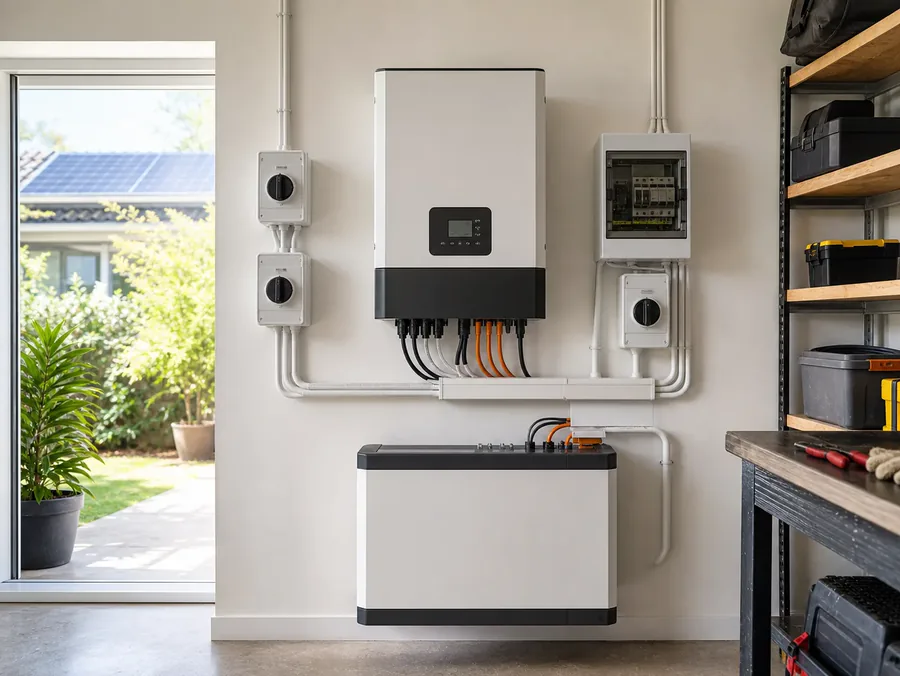
Peak shaving limits how much power a site imports from the grid during a high-load event. The controller watches the import at the point of supply. When demand approaches the chosen limit, it can reduce flexible loads, dispatch a battery or use available on-site generation.
These bill components should be kept separate:
| Bill component | Typical unit | Can peak shaving reduce it? | Main check |
|---|
| Energy charge | c/kWh or R/kWh | Sometimes, if solar replaces imports; battery losses can increase total imported kWh | Time-of-use period and energy flow |
| Measured demand charge | R/kW or R/kVA | Potentially | Billing interval, chargeable window and monthly maximum |
| Network capacity or notified demand | R/kVA or fixed amount | Not automatically | Contracted capacity and reduction rules |
| Fixed service or administration charge | R/month | Usually no | Tariff schedule |
| Reactive energy or power-factor charge | c/kVArh or tariff-specific | Only with the right electrical correction | Power factor and tariff method |
| Export credit | c/kWh or R/kWh | Separate from peak shaving | Export tariff, meter and approval |
The electricity tariff guide explains the main charge types. Use the current schedule for the exact Eskom or municipal tariff on the account. A label such as "business tariff" is not enough to model a demand saving.
Demand, energy and capacity are different
kWh measures energy
A site that uses 1,000 kWh over ten hours has consumed the same amount of energy whether the load was steady or sharply peaked. The bill can still differ if one profile creates a higher measured demand.
kW measures real power
kW describes the rate at which electrical work is being done. A battery inverter needs enough kW to cover the difference between the site's unshaved demand and the target import limit.
kVA includes reactive demand
Some commercial tariffs measure maximum demand in kVA. Motors, refrigeration, pumps and other inductive loads can increase apparent power when the power factor is poor. A 40 kW battery dispatch does not always cut billed demand by 40 kVA. The site's phase loading, power factor and the tariff's measurement method need to be included in the model.
kWh determines how long the battery can hold the limit
If a site needs 80 kW of support for 30 minutes, the event uses 40 kWh before conversion losses and reserve. If it needs the same support for two hours, the energy requirement is 160 kWh before those adjustments. The battery must satisfy both the power and duration requirements.
Read the tariff definition before modelling the peak
The billing rule decides which event matters. Record:
- whether demand is measured in kW or kVA;
- the averaging interval used by the meter;
- whether all hours or only peak and standard periods are chargeable;
- whether the monthly amount has a minimum-demand floor;
- whether a notified maximum demand or contracted capacity creates a separate charge;
- how season, voltage and point of delivery change the rate; and
- whether VAT is included in the published figure.
Eskom's 2026/27 Schedule of Standard Prices defines chargeable demand as the highest average kVA in the billing month during the tariff's chargeable periods. For tariffs such as Megaflex, the chargeable periods are the peak and standard periods. The same schedule defines annual utilised capacity using the higher of notified maximum demand or the maximum registered over a rolling 12-month period. Those are different billing mechanisms, so reducing one recorded peak does not imply that every capacity-related line falls.
Municipal tariffs use their own definitions. Check the final approved schedule, not a previous year's rate or a tariff from another city.
A dated City Power example
The City of Johannesburg's final 2026/27 budget lists an industrial time-of-use low-voltage demand charge of R461.28 per kVA per month for both summer and winter. The same tariff also lists separate service, network and time-of-use energy charges. The published tariff includes a minimum-demand determination, which means the measured reduction is not automatically the billed reduction.
Consider an editorial example checked on 23 September 2026:
| Input | Assumption |
|---|
| Billed demand before the project | 300 kVA |
| Billed demand after verified control | 260 kVA |
| Difference | 40 kVA |
| Published demand rate | R461.28/kVA/month |
| Gross demand-component difference | R18,451.20/month |
The arithmetic is 40 kVA x R461.28 = R18,451.20. It is not a project quotation or guaranteed saving. The actual account may be constrained by its minimum demand, notified capacity, chargeable-period rules, VAT treatment or another tariff line. The battery also has capital, finance, maintenance, replacement and conversion-loss costs.
Use the City of Johannesburg 2026/27 final budget for the source tariff and confirm the live account with City Power before making an investment decision.
Find the peaks that set the bill
Monthly bills can show the billed maximum, but they do not explain what created it. Obtain half-hourly or finer interval data for at least a representative year where possible. The commercial site assessment guide explains how to prepare and quality-check that data.
For each monthly maximum, identify:
- the date, time and measured kW or kVA;
- which equipment was operating;
- the duration and shape of the event;
- the phase loading and power factor;
- solar production and weather at the time;
- generator or battery operation;
- whether the event fell in a chargeable tariff period; and
- whether it was normal operation, a start-up, a fault or a rare production run.
A battery designed around one short compressor start may be wrong for a two-hour refrigeration peak. A target based on a shutdown month may also fail when production returns to normal.
Use the cheapest control first
Change the operating sequence
The lowest-cost peak may be one the site can avoid. Stagger motor starts, move charging or pumping, adjust heating and cooling schedules, or prevent several large loads from starting together. Operations must confirm which loads can move without affecting safety, product quality or output.
Use solar where the peak is reliably daytime
Solar can lower grid demand when the load and production overlap. It works best against broad daytime peaks. It is less dependable for an early morning peak, an evening peak or a short event under passing cloud. The model should use coincident solar generation, not annual kWh divided by the number of working days.
Dispatch a battery against an import target
A battery energy management system can watch the grid meter and discharge as demand approaches a set point. This is more controllable than solar alone, but the controller needs timely meter data, adequate inverter power and enough energy for the full event.
The operating policy must also decide how peak shaving ranks against backup. Energy held for an outage cannot always be used to reduce demand. A project that promises both full backup reserve and aggressive daily shaving from the same capacity needs a clear dispatch priority.
Size the control problem before the battery
Use this sequence:
- Choose the proposed grid-import limit. Base it on recurring chargeable peaks and the tariff floor.
- Calculate the required power. Subtract the target import from the site demand through each event.
- Calculate the event energy. Sum the required battery output over the relevant intervals.
- Allow for losses and operating reserve. Use warranted usable capacity and realistic round-trip efficiency.
- Test consecutive and cloudy days. The battery may start an event partly depleted.
- Check start-up and power-factor effects. kW, kVA and transient demand may require different solutions.
- Simulate the controller. Include meter delay, response time, state-of-charge limits and failed communications.
Ask the provider to show the unshaved demand, proposed limit, battery dispatch and residual billed maximum on the same interval chart. A monthly savings total without that trace is not enough.
Build the financial case from verified bill lines
The benefit model should separate:
- measured-demand reduction;
- time-of-use energy shifting;
- increased solar self-consumption;
- avoided generator use;
- backup or continuity value; and
- export revenue, if applicable.
Do not add the same battery discharge to several benefit categories. If stored solar is discharged during a peak period, the model must show whether its value is a demand reduction, an avoided peak-energy purchase, increased self-consumption or a combination that does not double count the same kWh.
Compare the benefits with:
- installed battery, inverter, control and meter cost;
- finance cost or contract escalation;
- conversion and standby losses;
- maintenance and monitoring;
- warranted throughput, degradation and augmentation;
- replacement assumptions;
- loss of backup reserve; and
- downside cases where the peak moves or operations change.
The commercial solar cost guide helps keep the equipment and project scope comparable. The business solar finance guide explains how ownership, maintenance and total cash paid change under different funding routes.
Prepare a commercial solar assessment
Bring your bills, operating hours, site details and critical loads. We will route the enquiry for a business assessment and provider quote.
Start a business assessment →Specify controls and verification in the proposal
A peak-shaving proposal should state:
| Requirement | What to request |
|---|
| Measurement point | Meter and current-transformer location used by the controller |
| Demand target | Import limit, season and chargeable periods |
| Dispatch priority | Order for peak shaving, backup, solar charging and time shifting |
| Reserve | Minimum state of charge and conditions that may override it |
| Response | Meter interval, control latency and fail-safe behaviour |
| Power limits | Continuous and short-duration kW or kVA capability |
| Energy limits | Usable kWh, efficiency and degradation assumption |
| Monitoring | Interval data, alarms, remote access and data ownership |
| Verification | Baseline, excluded events and method for calculating achieved savings |
| Support | Response time, maintenance scope and responsibility for control changes |
The acceptance test should reproduce a controlled demand event where practical and confirm that the import limit, alarms and fail-safe settings work. Ongoing reports should compare the tariff's billed maximum with the controller data, not only show battery cycles or solar yield.
What each reviewer needs
Finance
Finance needs the current tariff, interval baseline, achievable billed-demand reduction, benefit categories, capital or payment schedule, degradation, replacement and downside cases.
Facilities and engineering
The technical team needs the load trace, phase and power-factor data, meter arrangement, transformer and switchgear limits, control sequence, backup reserve, communications and commissioning plan.
Operations
Operations must approve load scheduling, production constraints, critical loads and the conditions under which the controller may shed or defer equipment.
Procurement and legal
These reviewers need performance definitions, data access, warranty limits, maintenance, availability, response times, change control and responsibility when a tariff or operating profile changes.
Sources and review note
This guide was checked on 23 September 2026 against Eskom's 2026/27 tariff page and Schedule of Standard Prices, and the City of Johannesburg's final 2026/27 budget. Tariffs, charge definitions and rates change. Use the schedule and account terms for the site's actual electricity distributor, voltage, connection and billing period. A qualified electrical professional and tariff specialist should confirm the technical design and savings model.
SolarGuide is an independent referral partner, not the electricity distributor or project engineer. The business solar hub explains the assessment and referral route. Alumo provides its own assessment, design, finance terms, installation and warranties. Final savings, battery size and pricing depend on measured site data and the signed scope.
Frequently asked questions
What is peak shaving in a commercial solar system?
Peak shaving limits the maximum power imported from the grid during a billing interval. The site can schedule loads, use coincident solar or discharge a battery when demand approaches a target. It only reduces a demand charge when the control changes the maximum that the tariff bills.
Can solar panels reduce a demand charge without a battery?
Yes, when the billed peak repeatedly occurs during strong solar production and the load is broad enough for generation to overlap it. Solar alone is less reliable when peaks occur outside daylight hours, are short and unpredictable, or coincide with poor weather.
How much battery capacity is needed for peak shaving?
It depends on both power and duration. The inverter needs enough kW to cover the gap above the target, while the battery needs enough usable kWh to maintain that output through the event after losses and reserve. Interval data is required for a credible answer.
Is maximum demand billed in kW or kVA?
Either may be used, depending on the tariff. kW measures real power and kVA includes reactive demand. If the account bills kVA, power factor and equipment behaviour must be included rather than treating battery kW as an equal kVA reduction.
Does peak shaving also reduce notified maximum demand?
Not automatically. A measured-demand charge, notified maximum demand and network-capacity charge can use different rules and time horizons. Confirm the process and consequences before applying to change contracted capacity.
What should a business provide for a peak-shaving assessment?
Provide the current tariff schedule, at least 12 months of bills, interval kW or kVA data, operating schedules, load and motor information, power-factor data, existing solar or generator records, and the required backup reserve. Start a business assessment with those records ready.
SolarGuide is an independent referral partner. We help you compare options and arrange a free quote — Alumo supplies, installs, finances and warrants the systems. Pricing is indicative, sourced from Alumo’s published catalogue, and subject to a site assessment and credit approval.