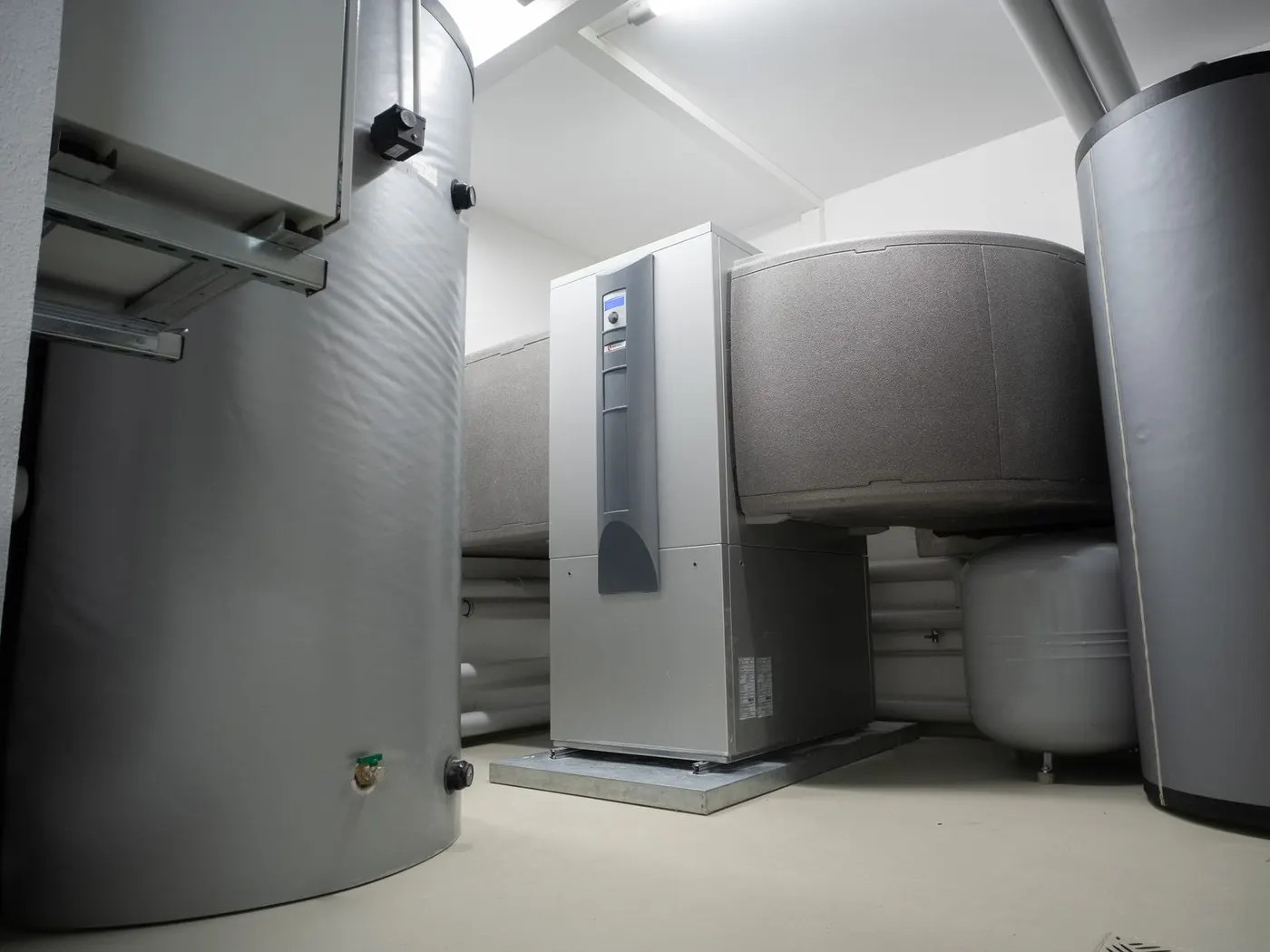
Why the geyser is the place to start
The 2024 South African water heating study by Lawrence Berkeley National Laboratory (LBNL) and the University of the Witwatersrand puts water heating at 33% of residential electricity use, ranging from 6% in low-income homes to 54% in high-income homes. Eskom's own hot water factsheet says heating water uses more energy than anything else in the average household.
That energy goes two ways:
- Heating the water you use. Every litre you draw is replaced with cold water, and the element has to heat it back up. Heating one litre from 20°C to 60°C takes about 0.047kWh, so a household using 160 litres of hot water a day needs roughly 7.4kWh just for that.
- Standing losses. A hot tank leaks heat through its insulation, fittings and pipes all day, and the element switches on to replace it even when nobody opens a tap. Under South Africa's efficiency rules, a 150-litre geyser made since 2016 may lose no more than 1.40kWh in 24 hours. The earlier limit was 2.59kWh.
Our geyser cost calculator uses these same figures to work out what your geyser uses and costs each month.
What a geyser timer can and can't save
A timer only decides when the element is allowed to heat. It can't change how much hot water you use, so it does nothing to the first and largest part of the bill. What it can do is:
- Trim standing losses. While the timer is off, the tank cools slowly. Cooler water loses heat a little more slowly, so less energy is needed to top it back up. The LBNL study describes timers as typically reducing standing losses by providing hot water only when needed.
- Shift heating to cheaper hours. On a time-of-use tariff, heating at off-peak rates instead of peak rates cuts the price of every unit the geyser uses.
- Point heating at solar production. With solar PV, a timer can make the geyser heat when the panels have spare output, so the energy costs you nothing extra.
The common belief that switching the geyser off for most of the day saves a fortune doesn't hold up for a modern, well-insulated tank. A full tank loses only a few degrees over many hours, and the element replaces that heat once the timer switches back on.
Worked example: a timer on a flat tariff
To put rands on this, SolarGuide modelled a 150-litre geyser with a 3kW element, set to 60°C, in a ceiling space at 20°C. Without a timer it heats whenever needed. With a timer it may heat only from 04:00 to 07:00 and from 15:00 to 19:00. We ran two cases, one with no hot water drawn and one with a 60-litre draw at 06:30 and another at 19:30, and priced the difference at R3.56 per kWh. That is the 2026/27 Eskom Homepower rate including VAT (energy, network demand and ancillary charges, before the fixed daily charges).
| Geyser | Saving with no hot water used | Saving with morning and evening showers |
|---|
| Made since 2016 (1.40kWh a day standing loss) | about 1kWh a month, roughly R4 | about 10kWh a month, roughly R35 |
| Older geyser with bare pipes (about 4.1kWh a day measured in homes) | about 9kWh a month, roughly R33 | about 34kWh a month, roughly R120 |
These are SolarGuide estimates from a simple cooling model, not measurements. The model treats the tank as evenly mixed, while a real geyser keeps its hottest water at the top. The bigger saving in the shower case comes from leaving the tank part-cold after each draw until the next heating window, which also means less hot water is ready between windows. The older-geyser loss is the 172W median standby loss that the LBNL study measured for 150-litre geysers in Eskom household load data, which includes heat lost through connected pipes.
So a timer on a newer geyser is worth having but won't transform your bill. On an older geyser with unlagged pipes it saves more, and a geyser blanket and pipe lagging attack the same losses directly.
Set the thermostat to 60°C first
The thermostat often matters as much as the timer. The LBNL study found that geysers commonly leave the factory set to the maximum of 70°C, and that geyser thermostats are not very precise.
Standing losses rise with the gap between the water and the air around the tank. With the tank in a 20°C ceiling, dropping from 70°C to 60°C cuts that gap from 50 to 40 degrees, which is about 20% less standing loss. A geyser that loses 1.40kWh a day at 60°C would lose about 1.75kWh at 70°C. At R3.56 per kWh, that difference is roughly R38 a month. Eskom's factsheet advises lowering the geyser to 60°C, and the City of Cape Town's "Top ways to save" leaflet says turning it down to 60°C can save up to 5% of your electricity bill.
Don't go much lower to chase extra savings. The World Health Organization's Legionella fact sheet says the bacteria grow at 20°C to 50°C and recommends keeping hot water above 50°C, which requires water leaving the heater to be at or above 60°C. Some people set 55°C. The saving is small, and 60°C is the setting that matches the WHO guidance. If you share a home with young children or older people, ask your plumber about a tempering valve to limit scalding at the taps instead of lowering the tank temperature.
Adjusting the thermostat means removing the element cover, where there are live terminals. Switch off the geyser isolator and let an electrician or plumber do it if you're not certain.
The best geyser timer settings for your situation
A 150-litre geyser with a 3kW element takes about 2 hours 20 minutes to heat a full tank from 20°C to 60°C. The common pairings of 100 litres with 2kW and 200 litres with 4kW take about the same time. In winter the incoming water is colder, so allow two and a half to three hours. Each window below is long enough for a full reheat.
Schedule A: a flat or block tariff
Most prepaid homes pay the same price per unit at any hour, so the only aim is to keep the tank from sitting hot when nobody needs it. Heat shortly before you use hot water, not hours earlier.
| Window | Suggested time | Why |
|---|
| Morning | 04:00 to 06:30 | Hot for morning showers, then off while the house is empty |
| Afternoon | 15:00 to 18:00 | Reheats water used in the morning before evening showers and cooking |
| Overnight and midday | Off | The tank coasts on stored heat |
Adjust the times to your household. If someone showers at 21:00, end the afternoon window later. If the tank runs out before the evening, it may be too small for your family, which our geyser cost calculator flags.
Schedule B: Eskom Homeflex or another time-of-use tariff
On a time-of-use tariff, the hour you heat matters far more than the standing loss. Eskom's 2026/27 Schedule of Standard Prices sets these Homeflex active energy charges, including VAT, per kWh:
| Homeflex energy charge (incl. VAT) | Peak | Standard | Off-peak |
|---|
| Low-demand season (September to May) | R3.95 | R2.46 | R1.91 |
| High-demand season (June to August) | R8.47 | R2.59 | R1.91 |
Network demand and ancillary charges of about 33.5c per kWh are added in every period, so they don't change the gap between periods. On weekdays, off-peak runs from 22:00 to 06:00 all year. The peaks are 07:00 to 09:00 and 18:00 to 21:00 in the low-demand season, and 06:00 to 08:00 and 17:00 to 20:00 in the high-demand season. Saturdays and Sundays have no peak periods.
That gives a simple weekday schedule:
- Main heat: 03:00 to 06:00, in off-peak, ending just before the high-season morning peak. Heating late in the off-peak window means the tank sits hot for less time before the morning showers.
- Afternoon top-up: a standard-rate window that finishes before the evening peak, for example 14:30 to 17:00 all year, or until 18:00 from September to May.
- Off during both peaks. A digital timer with separate weekday and weekend programmes lets you relax the schedule on weekends.
Worked example. Reheating the water from one 60-litre shower takes about 2.8kWh. If that reheat happens in the evening peak instead of off-peak, it costs about R5.70 more each weekday in the low-demand season and about R18.30 more in the high-demand season. Over 22 weekdays, that's roughly R125 a month from September to May and R400 a month from June to August, for one shower's worth of hot water. This is where a timer earns its keep.
City of Cape Town customers can opt into the City's new Residential Time-of-Use tariff if they have a smart (AMI) meter. Its 2026/27 rates include VAT: from September to May, R4.19 per kWh at peak and R3.01 off-peak. Weekday off-peak is 22:00 to 06:00, and the peaks are 07:00 to 09:00 and 18:00 to 21:00. The tariff also carries monthly administration and capacity charges of about R685, so the geyser alone is rarely a reason to switch. Compare your options on our electricity tariff tracker before changing tariff.
Schedule C: a home with solar PV
With solar panels, the cheapest energy for the geyser is surplus solar in the middle of the day. Set the main heating window to the sunniest hours, roughly 10:00 to 15:00, and the tank will be hot for the evening.
There is a catch the timer can't solve on its own. A 3kW element needs about 3kW of spare solar output to heat entirely from the sun. When the panels produce less, or the house is using some of that power, the shortfall comes from the grid. On cloudy days and in winter you may still need a short early-morning grid window as a backstop. Use off-peak hours if you are on Homeflex, the time-of-use tariff Eskom requires for its direct customers with grid-tied generation.
The LBNL study notes that most installers wire the geyser as a non-essential load, so it doesn't drain the battery. It warns that unless the inverter and geyser controls are set up properly, solar PV won't provide much water heating. Many hybrid inverters can switch a load when there is surplus power, and smart geyser controllers can do the same job. Our guide to smart geyser controllers compares them, and our hybrid inverter explainer explains how the inverter decides where solar power goes.
To see the size of the prize: a two-adult household's geyser uses about 8.84kWh a day on our calculator's assumptions. Every one of those units heated from surplus solar instead of the grid saves about R3.56 at the Homepower rate. That makes the geyser one of the best uses of midday solar, which is why it belongs in the design conversation before panels are sized. If you are still choosing how to heat water, our guide to the types of geyser compares electric, solar, heat pump and hybrid options alongside PV.
If you are weighing solar partly to cut water heating, compare a solar quote that accounts for your geyser →. SolarGuide passes your details to Alumo, which assesses, installs and supports the system.
Not sure which system you need?
Get a free, no-obligation quote sized to your home, usage and budget. It only takes a minute.
Get your free quote →Types of geyser timer
| Type | What it is | Good for | Watch out for |
|---|
| Mechanical dial | Clock with push-in pins or segments, usually in the distribution board | Simple, cheap, fixed daily schedules | Models without a battery reserve stop during power cuts and then run late |
| Digital programmable | Electronic timer with several on and off times and weekday and weekend programmes | Time-of-use schedules | Check that it keeps time through power cuts |
| Wi-Fi smart switch | Timer you control from a phone app | Changing the schedule when plans change | Depends on Wi-Fi and the maker's app staying supported |
| Smart geyser controller | Replaces or adds to the thermostat, reads tank temperature, and may divert solar | Solar homes and anyone who wants temperature control and usage data | Higher cost, and it needs correct installation and setup |
Whatever you choose, the timer or the contactor it drives must be rated for the geyser's current. A 3kW element draws about 13A at 230V, and a 4kW element about 17A.
Installation: use a registered electrician
A geyser timer is wired into the geyser circuit at the distribution board, which makes it fixed electrical installation work. The Department of Employment and Labour states that only a registered electrical contractor may issue a Certificate of Compliance (CoC), after inspecting and testing the work. Keep the CoC: insurers and buyers may ask for it. Our guide to the electrical CoC for solar explains what the certificate covers.
Ask the electrician to label the timer, set it to your schedule, and show you how to override it for a day when you need extra hot water.
Frequently asked questions
Does a geyser timer save electricity?
Yes, but less than many claims suggest. It trims standing losses by keeping the tank from sitting hot when nobody needs it. On a geyser made since 2016 that is typically worth tens of rands a month, not hundreds. The large savings come from shifting heating to off-peak hours on a time-of-use tariff, or to midday solar.
What is the best time to switch on the geyser?
On a flat or block tariff, about two and a half hours before you need hot water, for example 04:00 to 06:30 and 15:00 to 18:00. On Eskom Homeflex, heat in weekday off-peak (22:00 to 06:00) and top up in a standard-rate afternoon window, avoiding both peaks. With solar panels, heat in the sunniest hours, roughly 10:00 to 15:00.
Is it cheaper to leave the geyser on all the time?
On a flat tariff with a modern, well-insulated geyser, the difference is small. A timer still saves a little and costs nothing to run. On a time-of-use tariff, leaving the geyser on is usually more expensive, because it will reheat during peak periods.
What temperature should my geyser be set to?
60°C. It is the setting Eskom recommends for saving energy, and it matches the World Health Organization's guidance that water leaving the heater should be at or above 60°C to control Legionella. Many geysers leave the factory at 70°C, so check yours.
Is SolarGuide the installer?
No. SolarGuide is an independent referral partner. Alumo supplies, installs, finances and warrants the solar systems we refer. We help you compare options and get a free quote. All pricing is indicative and subject to a site assessment and credit approval. For a geyser timer on its own, use a registered electrician.
Sources and review note
Checked on 20 October 2026. Water heating's share of household electricity, the 150-litre standing-loss limits (1.40kWh a day since 2016, 2.59kWh before), the measured 172W field standby loss, factory thermostat settings, the description of timers and the solar PV control warning come from the LBNL and Wits South Africa residential water heating study (May 2024). The 60°C recommendation is from Eskom's hot water and geyser management factsheet, and the "up to 5%" figure is from the City of Cape Town's Top ways to save leaflet. Legionella temperatures are from the World Health Organization. Homepower and Homeflex rates and time-of-use periods are from Eskom's Schedule of Standard Prices, 1 April 2026 to 31 March 2027 (Tables 12, 13 and 16, and Appendix A). Cape Town's Residential Time-of-Use rates are from the City's 2026/27 electricity tariff annexure. CoC rules are from the Department of Employment and Labour. The timer, thermostat, time-of-use and solar savings are SolarGuide calculations from the stated assumptions, not measured results. Your own savings depend on your geyser, hot water use, tariff and schedule.
SolarGuide is an independent referral partner. We help you compare options and arrange a free quote — Alumo supplies, installs, finances and warrants the systems. Pricing is indicative, sourced from Alumo’s published catalogue, and subject to a site assessment and credit approval.