Red flag 1: Pressure and artificial urgency
The oldest trick in the book is manufactured scarcity. "This price is only valid today." "We have one system left in the warehouse." "Load-shedding is getting worse, you need to sign now."
A legitimate solar purchase is a considered decision worth tens of thousands of rands. Any genuine installer expects you to compare quotes and think it over. Urgency exists to stop you doing exactly that, because comparison and reflection are how scams get caught. If someone will not let you sleep on it, walk away.
Red flag 2: Big cash deposits and odd payment demands
Be very cautious about anyone demanding a large upfront cash payment, an EFT to a personal account rather than a registered company, or the full amount before any equipment arrives on site.
Reputable installers use staged, documented payments and proper company banking details. A request to pay a personal account, to pay in cash for a "discount", or to transfer everything before work begins is a classic setup for a disappearing act. Always check that the bank account name matches the registered company name.
Red flag 3: No Certificate of Compliance or SSEG registration
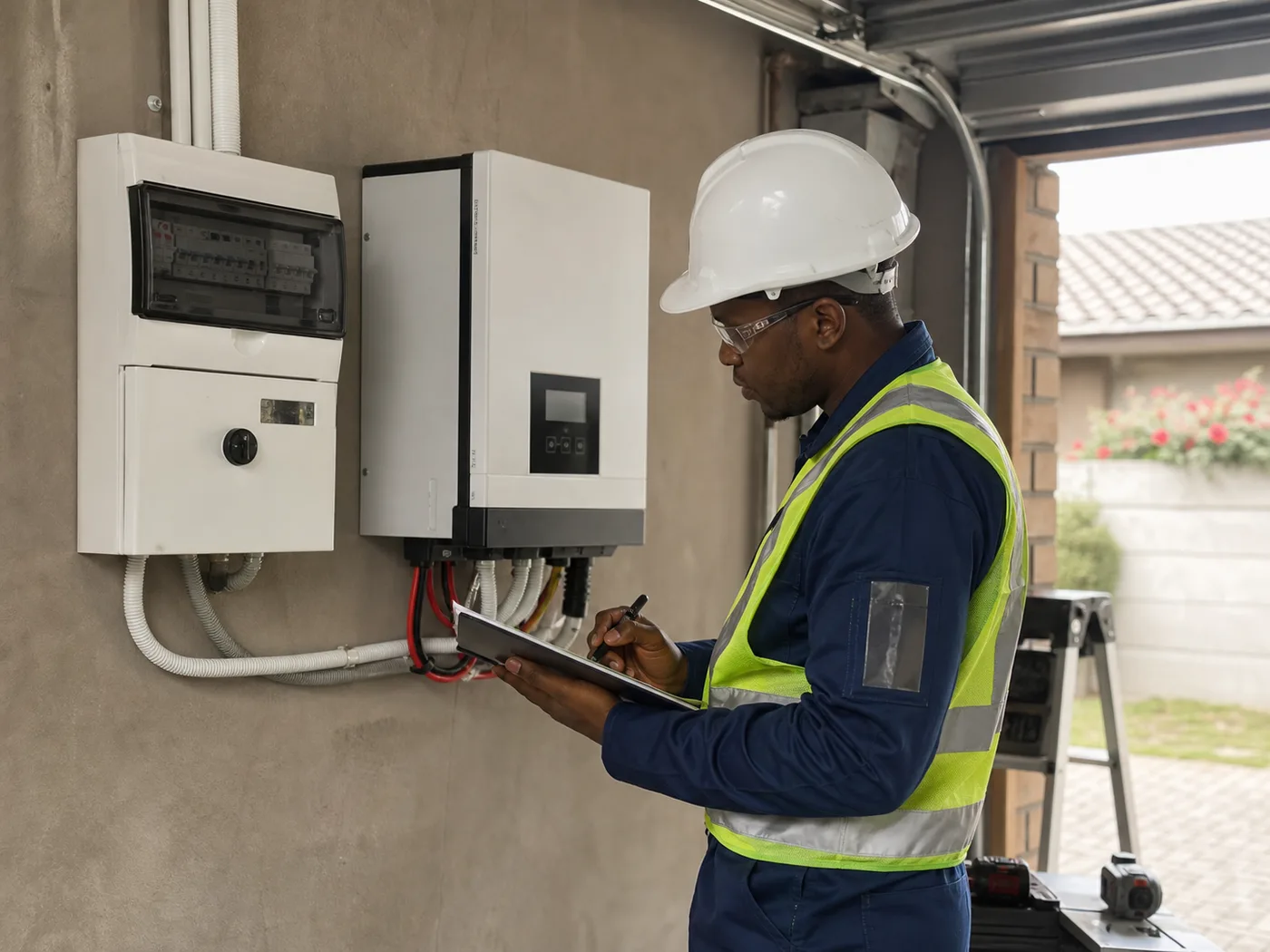
This is the red flag that costs people the most, because it is invisible until something goes wrong. Every solar installation that touches your home's wiring needs a Certificate of Compliance (CoC) from a registered electrician, and every grid-tied system must be registered as Small-Scale Embedded Generation (SSEG) with your municipality.
If an installer shrugs these off, cannot issue a CoC, or tells you registration is "not necessary", stop. An uncertified installation can void your home insurance, fail when you sell the house, and in a worst case burn it down. Ask directly: "Who issues the CoC, and will you handle my SSEG registration?" A blank look is your answer.
Red flag 4: Vague equipment and no model numbers
"5kW inverter and a lithium battery" is not a specification, it is a hiding place. Without exact brands and model numbers you have no idea what you are getting, and no way to check the warranty.
Insist on a quote that names the inverter, battery and panels precisely. Reputable inverters in SA include Sunsynk, Solis, Huawei, AlphaESS and Sigenergy; quality batteries include Sunsynk, AlphaESS, Eenovance, Sigenergy and IES; panels are commonly Trina or Jinko. Unbranded or "equivalent" hardware, or specs that change between the conversation and the invoice, are a warning that corners are being cut.
Not sure which system you need?
Get a free, no-obligation quote sized to your home, usage and budget. It only takes a minute.
Get your free quote →Red flag 5: Promises that defy physics
If it sounds too good to be true, it is. Watch for claims like "you will never pay Eskom again", "this battery runs your whole house including the geyser and oven all night", or "the system pays for itself in a year".
Solar is excellent, but it obeys physics. Batteries have finite capacity, panels only generate in daylight, and heavy loads like geysers and electric ovens drain storage fast. An honest installer will tell you what the system cannot do as clearly as what it can. Wildly optimistic promises are either ignorance or bait.
Red flag 6: No physical address, no track record, no reviews
Scam operations are deliberately hard to find later. Before you engage anyone, check for a real registered company, a physical address, a trading history longer than the current load-shedding cycle, and independent reviews rather than glowing testimonials on their own site.
Ask to see recent installations in your area, ideally with a reference you can phone. A company that has done good work nearby will happily point you to it. One that dodges the question is telling you something.
How to verify an installer quickly
A few minutes of homework filters out most bad actors:
- Confirm the company is registered and the bank account matches the company name.
- Ask which registered electrician issues the CoC.
- Search the company name alongside words like "complaint" or "scam".
- Ask for two recent local references and actually call one.
Red flag 7: The lowball quote that isn't
Not every scam is outright theft. A common one is the quote that undercuts everyone else because it quietly excludes the things you need: a smaller battery than discussed, no mounting or cabling costs, no CoC, no SSEG registration, or a paper-thin warranty.
The fix is to compare like for like. When you normalise every quote to the same brands, capacities, warranties and included compliance work, the suspiciously cheap option usually reveals what it left out. Cheap upfront often means expensive later.
How to buy safely instead
Protecting yourself is mostly about slowing down and insisting on documentation. Get multiple written quotes with exact model numbers. Confirm the CoC and SSEG registration are included. Check warranties on every component and on the workmanship. Verify the company is real and reviewed. And never let urgency or a cash-deposit demand rush you.
One of the simplest ways to sidestep the whole minefield is to compare a written quote from an established installer. SolarGuide can arrange a free quote from Alumo, which supplies, installs and warrants its systems with compliance built in. Use it as a transparent benchmark against other offers, then compare the equipment, scope, warranties and final price before you decide. Get a free quote here →.
If you would rather compare a transparent, fully documented quote against whatever else you have been offered, get a free Alumo quote → and use the red flags above to test everything else on the table.
Frequently asked questions
What is the most common solar scam in South Africa?
The most common problem is not dramatic theft but the "cheap but incomplete" quote combined with high-pressure sales. An installer undercuts rivals by excluding the battery capacity, warranty or compliance paperwork you actually need, then pushes you to sign before you can compare. Insisting on like-for-like written quotes exposes it.
How do I check if a solar installer is legitimate?
Confirm the business is a registered company, the bank account name matches, and a registered electrician will issue your Certificate of Compliance. Look for a physical address, a real trading history, independent reviews, and recent local installations you can verify with a reference call.
Is it a red flag if an installer wants full payment upfront?
Yes. Reputable installers use staged, documented payments through proper company banking, not full cash upfront or transfers to personal accounts. A demand for the total before equipment arrives on site is a classic setup for a vanishing installer.
Can a bad solar installation affect my home insurance?
Absolutely. An installation without a valid Certificate of Compliance can void your home insurance and cause problems when you sell your property. Compliance is not a technicality, it is what makes the installation legal and insurable.
What should I do if I think I've been scammed?
Stop any further payments immediately, gather all your documentation and communication, and report the matter to your bank and the relevant consumer protection channels. For future safety, only engage installers who provide a CoC, handle SSEG registration, and put full specifications and warranties in writing.
SolarGuide is an independent referral partner. We help you compare options and arrange a free quote — Alumo supplies, installs, finances and warrants the systems. Pricing is indicative, sourced from Alumo’s published catalogue, and subject to a site assessment and credit approval.